When someone asks ChatGPT, Gemini or Copilot for “a good electrician near me,” the answer isn’t made up on the spot. It is pulled from somewhere: Google’s index, Google Maps, Yelp reviews, Reddit threads, Wikipedia, product feeds. If your business isn’t in those sources, or is described badly in them, the AI has nothing good to say about you.
The question worth asking is which of those sources actually matter, and which ones a small business can do anything about.
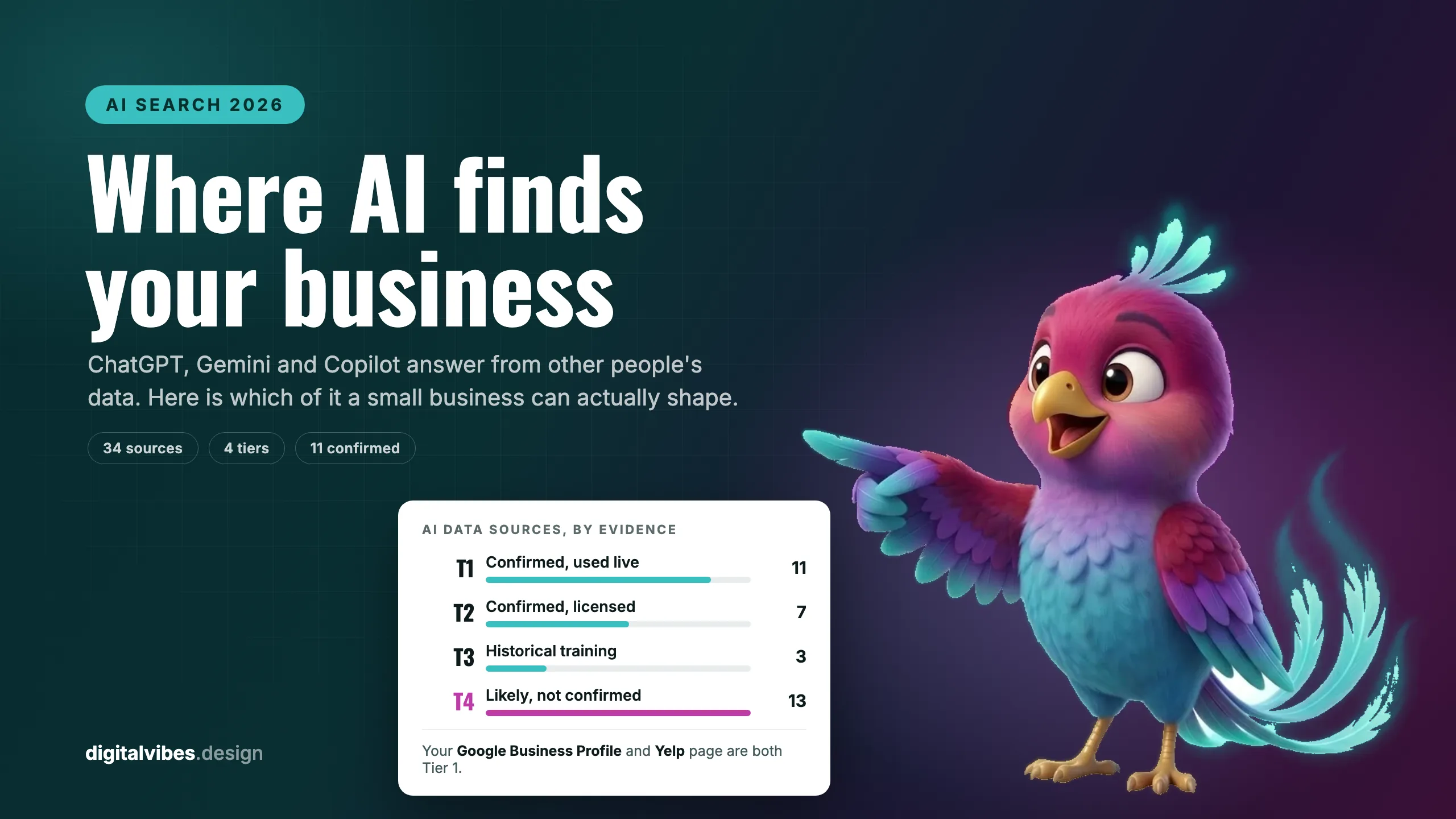
Credit where it is due. This post is built on Chris Green’s research, Which Data Sources Should You Care About for AI Search?, published September 19, 2026 on his Substack and also on Search Engine Journal. Chris sorted 34 data sources into four tiers by how strong the evidence is that AI tools use them. His table is the research. What we added is the small business translation: which rows you can act on this week, and which ones you can ignore.
A note on freshness. AI search is new and changing month to month. Deals get signed and dropped, features launch and get pulled, and some of what is below may already be out of date by the time you read it. Chris says the same about his own table: it “may date badly.” Treat this as a snapshot from September 2026, not a permanent rulebook.
The short answer
- Your Google Business Profile and Google Maps listing are the biggest lever you have. Gemini can ground answers in Google Maps data, and Chris puts both in Tier 1.
- Yelp is now a direct pipeline into ChatGPT. Yelp’s reviews, ratings, photos and business details show up inside ChatGPT, and people can book or request quotes without leaving the chat.
- Plain Google and Bing search still matter. AI tools look things up live, so the pages that rank are the pages that get quoted.
- Reddit, Wikipedia and news are real sources, but they are hard for a local business to influence directly and easy to get wrong.
- Most of the “AI training data” conversation doesn’t apply to you. Common Crawl and old web archives shaped the models years ago. You can’t go back and change them.
For a one-picture version, our lesson on where AI gets its information maps which sources AI cites against which ones Google ranks.
How the tiers work
Chris sorts every source by evidence, not by hype. Here is what each tier means in his words, plus what it means for a business with a small marketing budget.
| Tier | What it means | What to do with it |
|---|---|---|
| 1 | Confirmed and current. Used for live answers, grounding or actions | Work on these first. They pay off now |
| 2 | Confirmed and current, but for training or licensing deals | Useful to know. Mostly out of your hands |
| 3 | Confirmed historically, used to pretrain older models | Ignore. You can’t change past training data |
| 4 | Strong evidence or highly likely, but not confirmed | Cheap insurance. Keep them accurate, don’t obsess |
“Grounding” is the key word in Tier 1. It means the AI checks a live source before it answers and often links to it. If you want the plain-English version of how that retrieval works, we explained it in what RAG is and why it matters for your business.
Tier 1: the sources that shape answers today
These are the sources with confirmed, current evidence that AI tools pull from them live. The first four columns follow Chris’s table. The last column is ours.
| Source | Category | What the evidence says | What a small business should do |
|---|---|---|---|
| Google Business Profile | Local | Feeds Google’s local surfaces | Complete every field, pick the right primary category, keep hours current, post regularly |
| Google Maps | Local | Gemini can ground answers in Google Maps data | Same work as your profile, plus a correct pin, service area and photos |
| Yelp | Local | Yelp licenses reviews, photos and business info to OpenAI; users can book or request quotes in ChatGPT | Claim the page, match your name, address and phone to Google, answer reviews |
| Google Search | Web | Gemini’s Grounding with Google Search returns inline citations to source URLs | Have real service pages that rank. What ranks gets quoted |
| Bing Search | Web | Microsoft documents Bing results enhancing Copilot | Verify in Bing Webmaster Tools and claim Bing Places (our suggestion) |
| Google Merchant Center | Shopping | Merchant feed data underpins Google’s shopping surfaces | If you sell products, keep the feed clean: price, stock, images |
| Community | Google’s Reddit deal includes real-time API access and display across Google products | Be genuinely helpful in local subreddits. Never astroturf | |
| Wikipedia and Wikimedia | Reference | In disclosed training mixes and used as a live reference | Only relevant if you are genuinely notable. Don’t write your own page |
| Live publisher pages | News | Reached at answer time through search grounding | Local press, trade sites and chamber pages that mention you by name |
| Google Hotel Center | Travel | Real-time hotel prices in AI Mode, with booking via Google Pay since August 2026 | Only for lodging. Keep rates and availability synced |
Three of those rows are where most local businesses should spend their time.
1. Google Business Profile and Maps
These two are really one job. Your profile is what Google Maps knows about you, and Gemini can ground a local answer in that data. The fields that decide the map pack are the same ones an AI reads: primary category, business name, hours, reviews and photos. Our breakdown of the local search ranking factors shows which of those fields carry the most weight.
If your listing isn’t verified yet, start with how to verify your business on Google. If it is verified but you still can’t find yourself, why your business isn’t showing up on Google walks through the usual causes.
2. Yelp
This is the one most small businesses are underrating. Yelp’s August 2026 integration puts “Yelp’s trusted reviews, ratings, photos, and business details directly within the chat experience,” and lets people book a table, join a waitlist or request a quote from a service provider without leaving ChatGPT.
That changes Yelp from “a review site I should probably check on” into a source ChatGPT reads directly. If your Yelp page is unclaimed, has old hours, or has a different phone number than Google, fix it this week. Reviews matter here the same way they do on Google, so the playbooks for getting more Google reviews and responding to reviews carry straight over.
We looked at the paid side of ChatGPT separately. In short, ChatGPT Ads aren’t ready for local service businesses yet. Being named in the answer through your reviews and listings is worth more than a paid link under it.
3. Ordinary search rankings
AI tools look things up. When Gemini grounds an answer in Google Search, it cites the pages it found. When Copilot answers, Microsoft says Bing results help shape it. So the old basics still hold: a clear page for each service, your city in plain language, real answers to real questions. That is what SEO for AI search actually is. It is the same work as local SEO, not a separate discipline.
One small, easy win most businesses skip: claim your listing on Bing Places and verify your site in Bing Webmaster Tools. Chris’s table confirms Bing feeds Copilot. The Bing Places step is our own suggestion, based on the fact that local Bing results come from it. It takes about fifteen minutes.
Tier 2: confirmed, but mostly out of your hands
Tier 2 is licensing and training deals: OpenAI’s partnerships with publishers such as the Financial Times and Axel Springer, Reddit’s training deal with Google (which Chris notes may not be renewed), GitHub and Stack Overflow data.
There is one row here a small retailer can act on. OpenAI accepts merchant product feeds, structured catalog data “that helps ChatGPT surface the right products with accurate pricing, availability, and seller context.” If you sell products online, especially on Shopify, it is worth knowing this path exists. For a service business, skip it.
Tier 3: history you can’t change
Common Crawl, C4 and old news archives were used to pretrain earlier models. Chris cites GPT-3 drawing roughly 60% of its training mix from filtered Common Crawl, and LLaMA reporting 67%. That is interesting background, but there’s nothing to do. You can’t edit what a model learned in 2022. Your effort belongs in Tier 1, where answers are assembled fresh.
Tier 4: likely, so keep them tidy
Tier 4 is where the evidence is strong but not confirmed. For a local business, the relevant rows are:
| Source | Why it might matter | Effort level |
|---|---|---|
| Tripadvisor | Review and travel data. No confirmed AI deal found yet | Claim it if you are in food, lodging or tourism |
| Foursquare | Place data. Chris left it here on purpose: the OpenAI deal is Yelp’s, not Foursquare’s | Claim it once, keep it accurate |
| OpenStreetMap | Widely used open map data | Check that your pin and hours are correct |
| Wikidata | Structured entity data behind knowledge graphs | Only if you are genuinely notable |
| Forums and social platforms | Broad category, overlaps with Reddit | Be present where your customers already talk |
| Booking and reservation feeds | Google is testing agentic booking with partners like Booking Holdings and IHG | Use a booking tool that syncs with Google if you take appointments |
None of these are worth a big project. All of them are worth an hour, because a wrong address on a map app is the kind of mistake that spreads.
A one-afternoon checklist
If you only do a few things, do these, in this order:
- Audit your Google Business Profile. Category, hours, services, photos, description. This one change feeds Google Search, Google Maps and Gemini at once. Our free GBP scan grades it against the businesses ranking around you.
- Claim and match your Yelp page. Same name, address, phone and hours as Google. Reply to the last ten reviews.
- Claim Bing Places. Import from Google to save time.
- Check that your site has one clear page per service, with your city in plain words. If an AI can’t tell what you do and where, it won’t recommend you.
- Ask a few AI tools about your own business. Try “best [your service] in [your city]” in ChatGPT, Gemini and Copilot. Note who gets named and which sources they cite. Chris calls this the most meaningful research you can do, and he is right: the gaps show you exactly where to work.
What we are doing ourselves
We run Echo, our own AI assistant, on this site and on WhatsApp, so we see this from both sides: as a business that wants to be found by AI, and as a business building one. The lesson is the same either way. An AI answer is only as good as the data behind it. The businesses that keep their profiles, reviews and pages accurate are the ones that get named.
Frequently asked questions
Where does ChatGPT get its information about local businesses?
From a mix of live search results and partner data. The clearest confirmed local source today is Yelp: its reviews, ratings, photos and business details appear directly inside ChatGPT. It also relies on what it finds on the open web, including your website and mentions of you on other sites.
Does my Google Business Profile affect AI search?
Yes. Google’s Gemini can ground answers in Google Maps data, and your profile is what Google Maps knows about you. It is the single highest-leverage listing a local business has, for both the map pack and AI answers.
Do I need to be on Reddit or Wikipedia?
Usually not. Both are confirmed AI sources, but a local business rarely qualifies for Wikipedia, and promotional Reddit posts tend to backfire. If your customers already talk about your trade in a local subreddit, answering questions there helpfully is fine. Otherwise, spend the time on your profile and reviews.
Will this information change?
Almost certainly. AI search deals and features are shifting quickly, and Chris Green’s own table notes that some entries, like the Reddit and Google training deal, may not last. We will update this post when something important changes. The fundamentals (accurate listings, real reviews, clear service pages) have held up through every change so far.
The bottom line
AI search doesn’t invent its answers. It borrows them from a short list of sources, and for a local business the most important ones are already sitting in your control: your Google Business Profile, your Yelp page and your own website.
Thanks again to Chris Green for doing the hard part. His full table of 34 sources is worth bookmarking if you want the complete evidence behind each row.
Want to see where you stand right now? Our free local rank grid audit shows where you rank across your service area, and the free GBP scan grades the listing that feeds both Google Maps and Gemini.