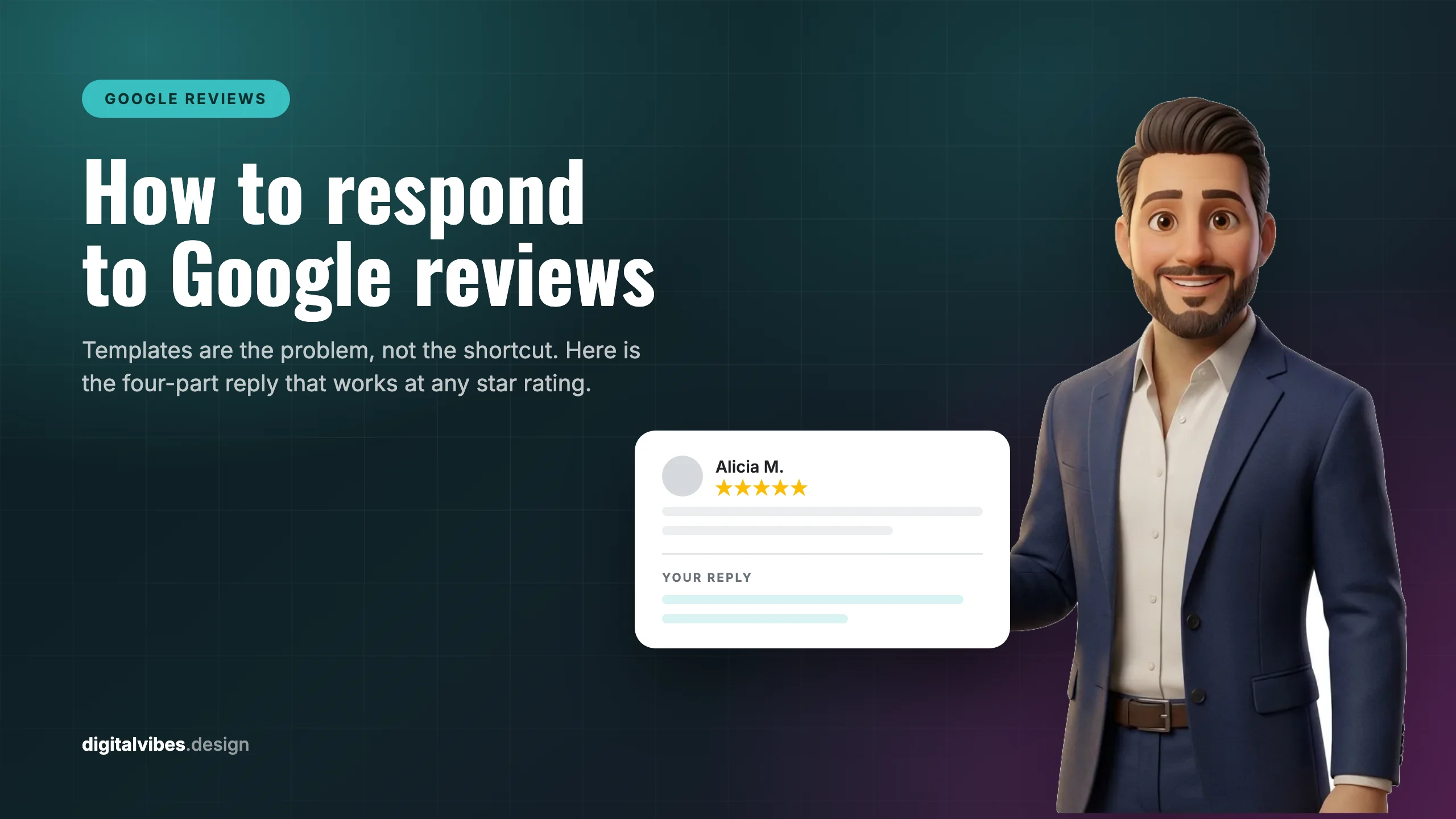
To respond to a Google review, open your Business Profile, select Read reviews, select Reply next to the review, write your reply, and select Reply again. That is the easy part, and it takes about fifteen seconds. The hard part is what goes in the box, because the same research that says you should reply also says 50% of consumers are put off by generic, templated replies. Most guides that rank for this question hand you a wall of copy-paste templates. Used as written, those templates are worse than saying nothing.
What works at every star rating is a four-part reply: thank the person, name one specific detail from their visit, answer the substance, and take the next step offline if there is one. Below are Google’s official steps, that formula applied to positive, negative, and star-only reviews, the lines that will get your reply rejected or land you in front of a regulator, and how fast customers now expect you to answer.
Key takeaways
- Replies are moderated. Google says they “usually take up to 10 minutes to review, but sometimes a review can take up to 30 days,” and the reviewer gets notified when yours is approved.
- 80% of consumers say they are likely to use a business that responds to all of its reviews (BrightLocal, 2026).
- Every partial strategy is penalized: 42% say they are unlikely to use a business that never replies, 45% one that answers only positive reviews, and 47% one that answers only negative reviews.
- 50% are put off by generic or templated replies, which is why a template used verbatim is a liability rather than a shortcut.
- Speed expectations moved sharply: 32% now expect a reply by the next day, up from 18% a year earlier, and 81% expect one within a week.
- AI reply tools write a good draft and cannot write the one detail that matters, so keep a human between the generator and the publish button.
How to reply to a Google review
Google’s own instructions are five steps (Google):
- “Go to your Business Profile”
- “Select Read reviews”
- “Next to the review you want to reply to, select Reply”
- “In the dialog box, enter your reply”
- “Select Reply”
You can reach your profile by searching your own business name while signed in to the account that manages it, or from the Google Maps app under your business listing. If you cannot find the profile or it does not appear at all, that is a different problem: start with how to verify your business on Google.
What happens after you hit reply
This is the step nobody mentions, and it explains most of the “my reply disappeared” panic.
Your reply does not go live immediately. Google says it “reviews your replies” against its content policies first, and while “replies usually take up to 10 minutes to review,” sometimes “a review can take up to 30 days.” If it clears, “it will be publicly posted under the customer’s review.”
Two consequences worth planning around. First, a reply that never appears was probably filtered, not lost, and rewriting it without the promotional language or the customer’s personal details usually fixes it. Second, and more useful: “The person who wrote the review is notified when you reply.” An unhappy customer will read what you wrote. That is the real audience for a one-star reply, even though the paragraph is being written for the hundred strangers who read it later.
The four-part reply that works at any rating
Every good reply, five stars or one, does the same four things:
- Thank them by name. One line. Use the name Google shows.
- Name one specific detail. The service, the date, the technician, the thing they mentioned. This is the single element a template cannot supply, and it is the difference between a reply that reads as human and one that reads as a macro.
- Answer the substance. Agree, explain, or correct. Briefly.
- Move it offline if there is anything to resolve. Give a real route back to you.
Google’s guidance on tone is short: be “professional and polite,” “keep it short and simple,” and be “conversational, not promotional.” That last one has teeth, because promotional language is one of the things the moderation filter catches.
Everything below is the same four parts pointed at a different situation. Read them as structure, not as script. If you paste any of these without changing the specifics, you have written exactly the reply that half of consumers say puts them off.
Responding to positive reviews
The mistake here is not rudeness, it is volume: fifty reviews all answered “Thank you for your kind words! We appreciate your business!” reads as an autoresponder, because it is one.
Four stars, specific praise:
Thanks, Marcus. Glad the new water heater install went smoothly, and good call flagging the shutoff valve while we were out there. If anything about the pressure seems off once you have run it a week, call me directly and we will come back out.
That reply names the job, references something only a real visit would surface, and leaves a door open. It is three sentences.
Five stars, no detail given:
When the review is just “Great service!”, you still have your own records. You know what you did for them.
Thank you, Priya. You were the same-day call on the Tuesday of the storm week, and I am glad we could get someone out before the weekend. Appreciate you taking the time.
Responding to negative reviews
This is where most businesses either go silent or go to war, and both are expensive. 42% of consumers say they are unlikely to use a business that never replies, and a defensive reply is read by every future customer, permanently.
The structure holds, with one change: do not relitigate the facts in public. State your position once, plainly, and move the detail offline.
A fair complaint:
Thank you for telling us, Dana. You are right that we quoted Thursday and did not arrive until the following Monday, and the two calls you made in between should have been returned. That is on us. I have credited the trip charge back to your card, and I would like to finish the job properly at no cost if you will have us. My direct line is on our profile.
A complaint you disagree with:
Thank you for the feedback, Alan. Our records show the estimate you approved on 3 March covered the panel replacement only, and the rewiring you are describing was quoted separately. I understand that was not what you expected, and I would rather sort it out than leave it here. Call the office and ask for me and I will walk you through the invoice line by line.
Note what that does not do: it does not accuse the customer of lying, it does not mention a refund it has no intention of giving, and it does not end with a marketing sentence.
A review you believe is fake or meant for another business:
Reply once, neutrally, then use the flag. Something like: “We have no record of a customer by this name and no job matching this description. If we have got that wrong, please contact the office so we can look into it.” Then report it through your profile. Do not threaten legal action to get it taken down, for reasons covered below.
Responding to star-only reviews
A three-star rating with no text is the hardest one, because you have nothing to work with and something is clearly wrong.
Thank you for the rating, Sam. Three stars tells me we got something wrong but not what, and I would genuinely like to know. If you have two minutes, the office line is on our profile and I will listen.
Consumers can see you tried. That is most of the value.
The template trap
Here is the uncomfortable part of the research. BrightLocal’s 2026 survey of 1,002 US consumers found that every partial approach to replying carries roughly the same penalty as no approach at all (BrightLocal):
Templated replies score worst of the four. Worse than silence. The reason is that a template is visible: your replies sit stacked on one page, and a visitor scrolling them sees the same sentence four times before they see yours.
The fix is not to write more, it is to write one true detail. Keep a three-sentence skeleton if you like, but the second sentence has to come from your job records every single time.
Here is that test run on one of our own replies. A customer wrote that we had designed their website and their business cards, that they were getting compliments on both, and that our work also ran on their business vehicle. The reply named all three back: the website, the cards, the vehicle. Not one clause of it could have been written before reading what they wrote, which is the whole point. The templated version, “thank you for your kind words about our design work,” would have quietly dropped the vehicle, and the vehicle was the detail they had gone out of their way to mention.
Using AI to write replies
Most review platforms now ship an AI reply generator, usually with a tone setting, and they are genuinely good. Hand one a review and it will return something fluent, warm, correctly structured, and free of the defensive edge that gets owners into trouble on a one-star. If the realistic alternative is a two-word thank-you or no reply for three weeks, the generated draft wins comfortably.
The catch follows directly from the section above. The model can only see the review. It cannot see your job records, so it cannot supply the one element that separates a real reply from a template: the detail proving that somebody who was actually there is writing. Left unedited, a fluent AI reply is a very well written generic reply, which is precisely what 50% of consumers say puts them off. It fails the same test, just more elegantly.
Used properly it is a drafting tool rather than an autopilot, which means guardrails:
- Never let it publish on its own. Generate, read, edit, then post. Auto-publish is the setting that turns one bad output into a permanent public one, and remember the reviewer is notified the moment it goes live.
- Give it the job, not just the review. Paste in what you actually did: the date, the technician, the part you replaced, the thing that went wrong. A model handed real facts writes a reply worth posting. A model handed only the review writes an eloquent shrug.
- Write the one-star replies yourself. Negative replies are where the stakes, the legal exposure and the reader scrutiny all peak, and they are the least suited to generation. A person should decide what the business concedes.
- Keep a ban list. No discounts, no refunds, no promises about timelines, no customer personal details, no admissions of fault. These are exactly the things a model offers on your behalf because they sound accommodating.
- Audit it on a schedule. Once a month, read your last ten replies straight down the way a stranger scrolling your profile would. Repeated openers and recurring cadence are invisible one at a time and glaring in a column.
Treat the output as a draft that can be confidently wrong. These tools will occasionally invent a service you do not offer, a policy you do not have, or a resolution you never agreed to, and it will read perfectly plausibly. Published under your business name on a page you do not control, anything it fabricates is a public commitment a customer can hold you to.
How fast you have to answer
Response speed expectations moved a long way in one year.
Same-day expectations tripled year over year, from 6% to 19%, and next-day expectations went from 18% to 32%. Practically, a weekly review sweep is now too slow for a third of your customers and fine for the rest. Twice a week clears the bar for almost everyone.
What never to put in a reply
Some of these get your reply filtered. Some of these are federal law.
- Customer personal information. No order numbers, addresses, medical or financial details, even to prove a point. Especially not to prove a point.
- Promotional language. Google asks for replies that are “conversational, not promotional.” A discount code in a review reply is both a moderation risk and an incentive problem.
- Any offer tied to changing or removing the review. Google’s policy prohibits merchants from offering incentives “in exchange for posting any review,” and lists offering “free or discounted goods or services” to get customers to “change reviews, or remove negative reviews” as strictly prohibited (Google). The FTC’s Consumer Reviews and Testimonials Rule, effective 21 October 2024, goes further and covers “implying that a review has to be positive in order for consumers to get an incentive” (FTC).
- Legal threats to get a review removed. The same FTC rule “prohibits a business from using unfounded or groundless legal threats, physical threats, intimidation, or certain false public accusations to prevent or remove a negative consumer review” (FTC). Violations carry civil penalties of up to $53,088 each, and this is not theoretical: on 22 December 2025 the FTC sent warning letters to ten companies over fake reviews and incentives paid for positive reviews (FTC).
The short version: answer the review, never trade for it, and never threaten the person who wrote it.
Does replying to reviews help you rank?
Google lists review responses on its own local ranking advice page, in the section on improving prominence: “When you reply to customer reviews, it shows that you value their feedback” (Google). Google does not quantify the effect, and nobody outside Google can.
What is measurable is the demand side, and it is large: 80% of consumers say they are likely to use a business that responds to all of its reviews. Treat ranking as the bonus and the booked job as the point. If you want the full picture of what actually moves map pack position, we broke the three ranking factors down in how to rank higher on Google Maps.
Frequently asked questions
How long does it take for my reply to show up?
Google says replies “usually take up to 10 minutes to review, but sometimes a review can take up to 30 days.” If yours has not appeared after a day, check it for promotional language, links, or customer personal details, then edit and resubmit.
Can I edit or delete a reply after posting it?
Yes. Go back to the review in your Business Profile and you can edit or delete your reply at any time. The edited version goes through the same moderation pass.
Should I reply to every single review, even a bare five stars?
Yes, and the survey data is unusually clear about why: consumers penalize selective replying almost as heavily as no replying, with 45% put off by businesses that answer only positive reviews and 47% put off by those that answer only negative ones. Partial coverage buys you very little over none.
Can I get a bad review removed?
Only if it violates Google’s content policies, for example if it is not based on “a genuine experience at a place or business,” is spam, or targets the wrong business. Flag it through your profile and let the process run. You cannot get an honest negative review removed for being negative, and trying to force it with legal threats is what the FTC rule specifically prohibits.
Should I use AI to write my review replies?
Yes, as a drafting tool with a person between it and the publish button. The guardrails are covered in full above; the short version is to feed it your job records rather than only the review, write the one-star replies yourself, and never switch on auto-publish.
What if the reviewer is not actually a customer?
Reply once, neutrally, stating you have no record of the job, then flag it. Keep the tone flat. Future readers are judging your composure, not your case.
The bottom line
Replying to Google reviews is a fifteen-second task and a three-sentence discipline. Answer all of them, not just the good ones or just the bad ones, because consumers punish selective replying nearly as hard as silence. Get to them within a day or two now that a third of customers expect it. And make the second sentence specific to that job, every time, because the generic reply that half of consumers dislike is the one thing a template guarantees.
Want to know whether replies are the gap, or whether you are missing the reviews to reply to in the first place? Our free 60-second GBP scan grades your profile against the businesses ranking around you, no signup. If reviews are thin on the ground, start with how to get more Google reviews. If you would rather hand the whole thing over, the $550 a month Google Business Profile plan covers review management, posting, and photos.