Your next customer might never type your name into Google. They’ll ask ChatGPT, Gemini or Google’s AI Mode for “a good med spa in Salinas” or “an electrician who can come today,” and the AI will name two or three businesses. You’re either one of them or you’re not.
That’s no longer a fringe habit. In BrightLocal’s 2026 Local Consumer Review Survey, 45% of US consumers said they had used AI tools to find local business recommendations, up from 6% the year before.
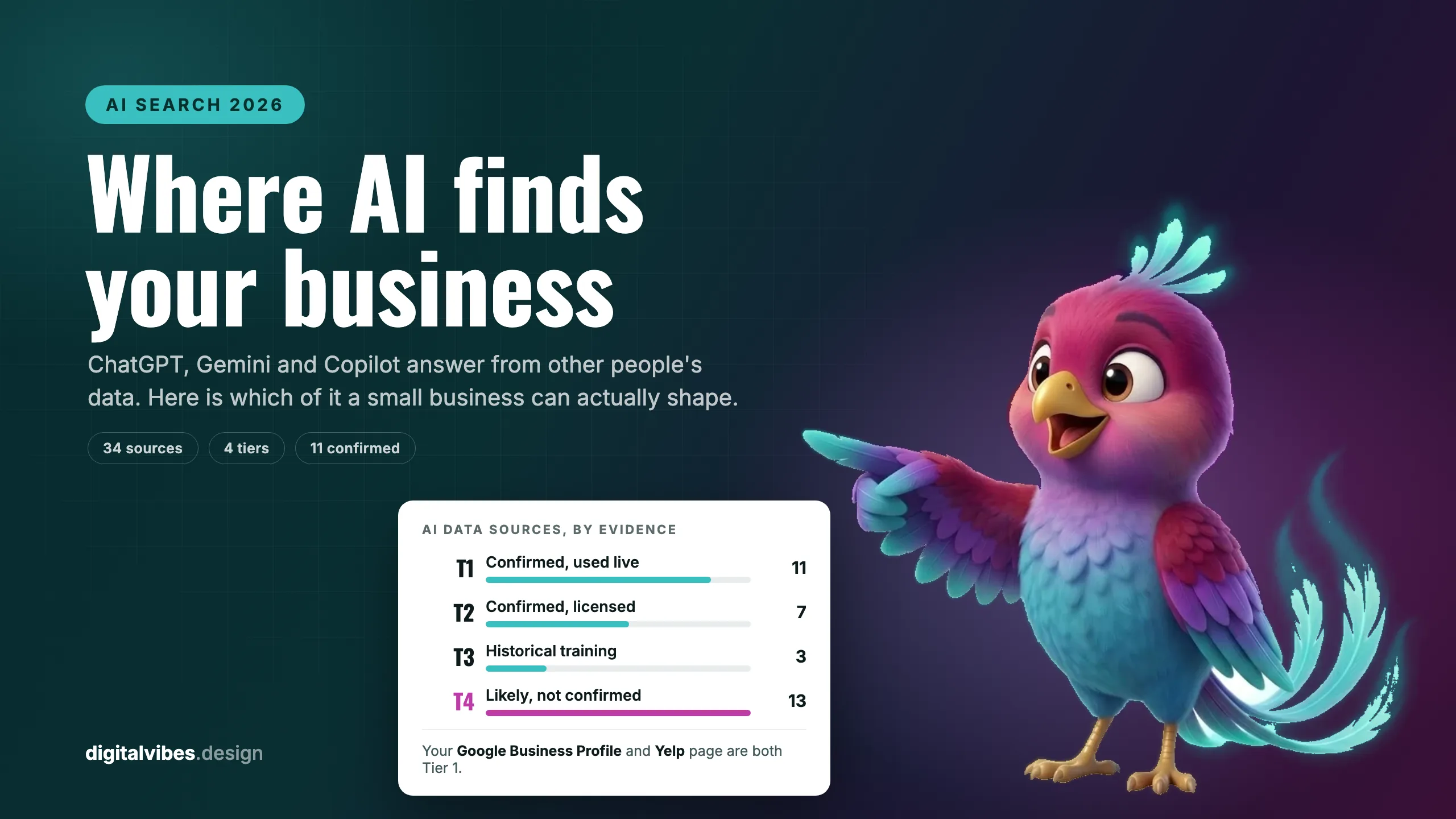
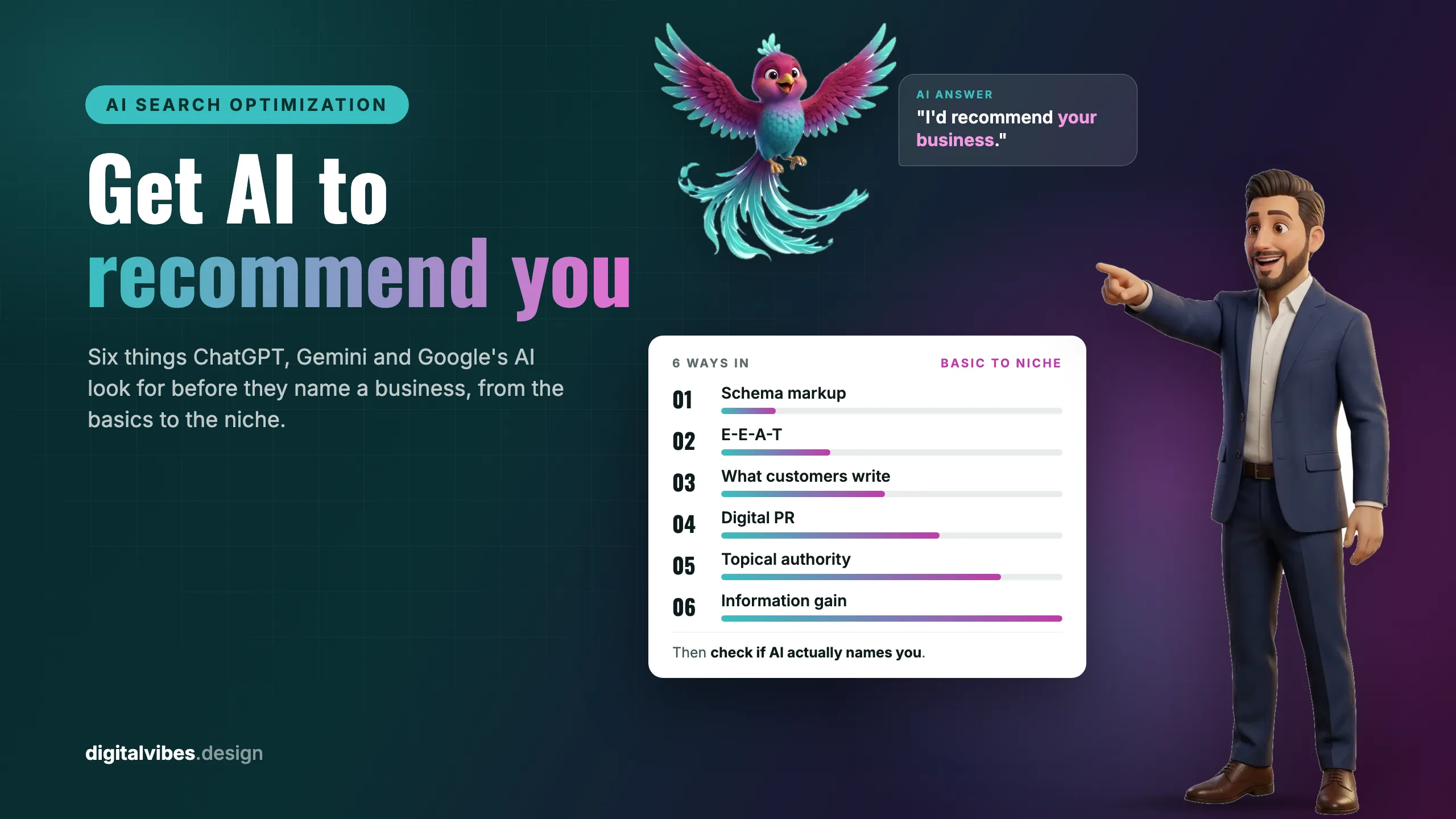
So how does an AI decide who to recommend? Nobody outside these companies knows the full recipe. But there are six things with real evidence behind them, and they go from the basics every business should have to the niche stuff most of your competitors haven’t heard of. (For where AI tools get their information in the first place, see which data sources AI search uses, or our interactive map of where AI gets its information.)
A note on freshness. AI search changes month to month. Everything below was checked against the original sources in September 2026, and each claim links to where it came from. Some of it will age. The principles behind it won’t.
The short answer
- Schema markup: code that tells search engines and AI exactly what your business is.
- E-E-A-T: proof of real experience, expertise, authority and trust.
- What your customers write: reviews, forum posts and social comments about you.
- Digital PR: other websites saying you’re good, instead of just you.
- Topical authority: going deep on what you actually do, not a little about everything.
- Information gain: saying something no other page says.
Then check whether AI is actually naming you. Here’s each one, what the evidence says, and what to do this month.
1. Schema markup: tell machines what you are
Schema markup is a small block of code on your website that labels the facts on the page: this is a business, this is its name, address and phone number, these are its hours, these are its services, this is its rating. Visitors never see it. Search engines and AI systems read it.
Google’s own documentation describes it as a way to provide “explicit clues about the meaning of a page.” Microsoft has gone further: at SMX Munich in March 2025, Bing’s Fabrice Canel said schema markup helps Microsoft’s LLMs understand your content, which matters because Bing’s index also feeds Copilot. Our Bing Webmaster Tools lesson shows where to see which of your pages Copilot cites.
To be straight about it: Google says you don’t need special markup to appear in AI Overviews or AI Mode, and “there’s also no special schema.org structured data that you need to add.” Schema isn’t a secret AI switch (here’s everything Google itself says about SEO and AI answers). It’s the foundation that removes guesswork about who you are, where you are and what you do.
What to do:
- Add
LocalBusinessschema (or a more specific type likePlumber,MedicalBusinessorHomeAndConstructionBusiness) with your exact name, address, phone, hours and service area. - Make it match your Google Business Profile word for word. Two versions of your address is two businesses to a machine.
- Only mark up what’s actually visible on the page. Google’s guidelines are strict about that.
2. E-E-A-T: prove a real expert runs this
E-E-A-T stands for Experience, Expertise, Authoritativeness and Trustworthiness. Google added the first E, for Experience, in December 2022.
It comes from Google’s Search Quality Rater Guidelines. According to Google’s own overview of the program, it works with about 16,000 external quality raters, hired through outside vendors, who judge search results against those guidelines. Their ratings don’t move any single site up or down. Google says it uses them to measure how well its systems work and as “positive and negative examples” to improve them. In other words, humans show Google what a trustworthy result looks like, and Google uses that to improve its systems.
What to do:
- Show the experience. Photos of your actual jobs, your team, your shop. Not stock photos.
- Put a real name on it. An owner or lead expert with a short bio, years in the trade, licenses and certifications.
- Make trust easy to check. License numbers, insurance, a physical service area, real reviews and a phone number that a person answers.
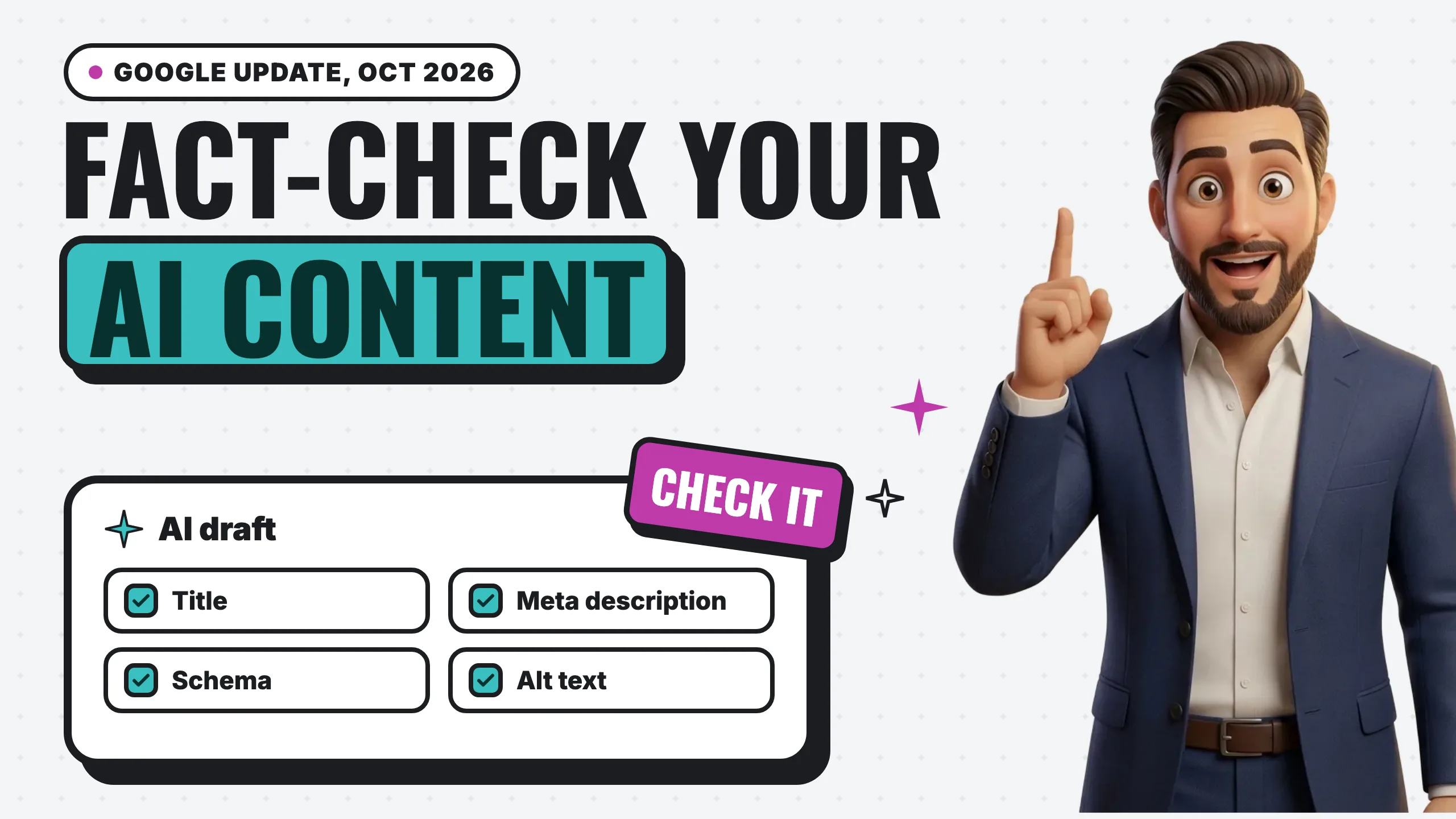
- If AI helps you write, check its facts. In October 2026 Google updated its guidance to say AI tools “don’t retrieve facts” and that every AI draft needs a manual fact-check before publishing, including titles, meta descriptions and schema. Here’s what changed.
3. Reviews and mentions: what your customers write
This is everything about your business that you didn’t write: Google and Yelp reviews, Facebook comments, Nextdoor recommendations, Reddit threads, forum posts comparing you to the shop down the street.
AI companies pay for this kind of content. Google signed an expanded partnership with Reddit in February 2024 for access to Reddit data, including to train on it. OpenAI followed in May 2024 with its own Reddit partnership, using Reddit’s data API so its tools can “better understand and showcase Reddit content.”
How much each AI leans on these sources changes fast. Semrush’s analysis of more than 100 million AI citations found Reddit’s share of ChatGPT citations fell from about 60% to about 10% between July and October 2025, and a later Semrush report saw it drop again in August 2026. So don’t chase one platform. What stays constant is that real people talking about you, in their own words, is evidence an AI can point to.
What to do:
- Ask every happy customer for a Google review, and ask them to mention the service and the city (“they fixed our water heater in Marina the same day”).
- Reply to every review, good and bad. A thoughtful reply to a bad review is its own trust signal.
- Don’t write fake reviews or pay for them. Beyond getting caught, the FTC’s rule banning fake reviews, finalized in August 2024, lets the agency seek civil penalties.
4. Digital PR: let someone else say it
If you say you’re the best plumber in Salinas on your own website, that’s an ad. If the local paper, the chamber of commerce and a supplier’s “where to buy” page say it, that’s evidence.
The best data on this so far comes from Ahrefs’ study of 75,000 brands. How often a brand was mentioned on other websites had a 0.664 correlation with how often it appeared in Google’s AI Overviews. Backlinks, the thing SEO has obsessed over for 20 years, came in at 0.218. Brands in the top quarter for web mentions got up to 10 times more AI Overview mentions than the next quarter. Two honest caveats: correlation isn’t proof of cause, and the study measured Google’s AI Overviews, not ChatGPT.
What to do:
- Get into local news: a new service, a milestone, a community project, a useful seasonal tip.
- Sponsor or show up at local events that list their sponsors online.
- Join your chamber of commerce and trade associations that have member directories.
- Ask suppliers, partners and manufacturers you’re certified with to list you on their sites.
5. Topical authority: be the expert on one thing
Most small business websites have a blog about a bit of everything. AI answers tend to name the business that clearly specializes, not the one that sort of knows a lot of things.
Google has described a “topic authority” system that helps surface expert sources, though it’s documented for news searches. And internal Google API documents that leaked in 2024 included a siteFocusScore, described as how much a site “is focused on one topic.” That’s a leak, not a confirmed ranking factor, and nobody outside Google knows how much it’s weighted. But the direction is consistent: a site that goes deep on what it actually does is easier to trust on that topic.
What to do:
- Give every main service its own page, and every city you serve its own page.
- Write articles that answer the real questions customers ask about those services before they book: cost, timing, what to expect, how to choose.
- Link those pages together so the whole topic hangs together, and stop publishing posts that have nothing to do with your work.
6. Information gain: say what nobody else says
This is the most niche one, and the most interesting.
Google holds a patent called “Contextual estimation of link information gain” (US11354342B2, filed in 2018 and granted in June 2022). It describes scoring a page by how much “additional information” it contains “beyond information contained in other documents that were already presented to the user.” In plain English: if your page just repeats what the other ten pages say, it adds nothing new.
A patent isn’t proof Google uses it in ranking. But it matches why an AI tool has little reason to cite a generic page: an answer doesn’t need the eleventh copy of the same advice. Saying it better isn’t enough. You have to say something the reader can’t get anywhere else.
What to do:
- Publish your real prices or price ranges, with what changes them.
- Share numbers only you have: how many jobs you did this year, your average response time, the most common problem you find in homes built before 1970.
- Use your own photos, before and afters, and local specifics: the neighborhoods, the permits, the weather, the building styles you deal with.
Then check whether AI actually mentions you
Once the six are in place, find out if any of it is working. Don’t just Google your business name. Ask the way a customer would, without your name in the question.
The free way: open ChatGPT, Gemini, Perplexity and Google’s AI Mode, and ask the three or four questions your customers ask (“best roofer in Watsonville,” “who does laser hair removal near Salinas”). Try it in a private browser window, try a few wordings, and write down who gets named. Do it again next month.
The tool way: AI visibility tools run those prompts for you on a schedule, compare you with competitors and track how you’re described. What each one covers, per the vendors’ own pages in September 2026:
| Tool | AI platforms tracked | Competitors | Sentiment | Starting price |
|---|---|---|---|---|
| Ubersuggest AI Search Visibility | ChatGPT and Gemini (Google AI on the top plan) | Yes | Yes | $29/mo |
| Semrush AI Visibility Toolkit | ChatGPT and Google AI Mode | Yes | Yes | $99/mo |
| Ahrefs Brand Radar | AI Overviews, AI Mode, ChatGPT, Gemini, Perplexity and Copilot (Claude through custom prompts) | Yes | Not listed | Included with any paid Ahrefs plan |
| Echo Website Report (ours) | Today: your Google rankings and the visitors who came from AI assistants like ChatGPT. Coming soon: whether ChatGPT, Gemini, Perplexity and Claude name you | Coming soon: who AI names instead | No | $15/mo |
One correction to a claim you’ll hear a lot online: at the time of writing, Ubersuggest doesn’t track Claude or Perplexity on any plan, so it won’t show you “every LLM.” If Perplexity or Claude matters to your customers, Ahrefs covers more platforms. For most local service businesses, ChatGPT, Gemini and Google’s AI are the ones customers are most likely to be using, and each of the three paid tools above covers at least two of them.
When a tool shows you missing from an answer, go back to the six. The fix is usually one of them: no schema, thin reviews, no one else mentioning you, or a website that says the same thing as everyone else.
Where to start
If you only do three things this month:
- Fix the basics: make your name, address, phone and hours identical everywhere, and add
LocalBusinessschema to your website. - Ask for five reviews that mention the service and the city.
- Write one page nobody else could write: your real prices, your process, your photos, your numbers.
The businesses that get recommended by AI aren’t gaming a new algorithm. They’re the ones with the most real evidence behind them. If you’d like a second pair of eyes on yours, start with a free audit.