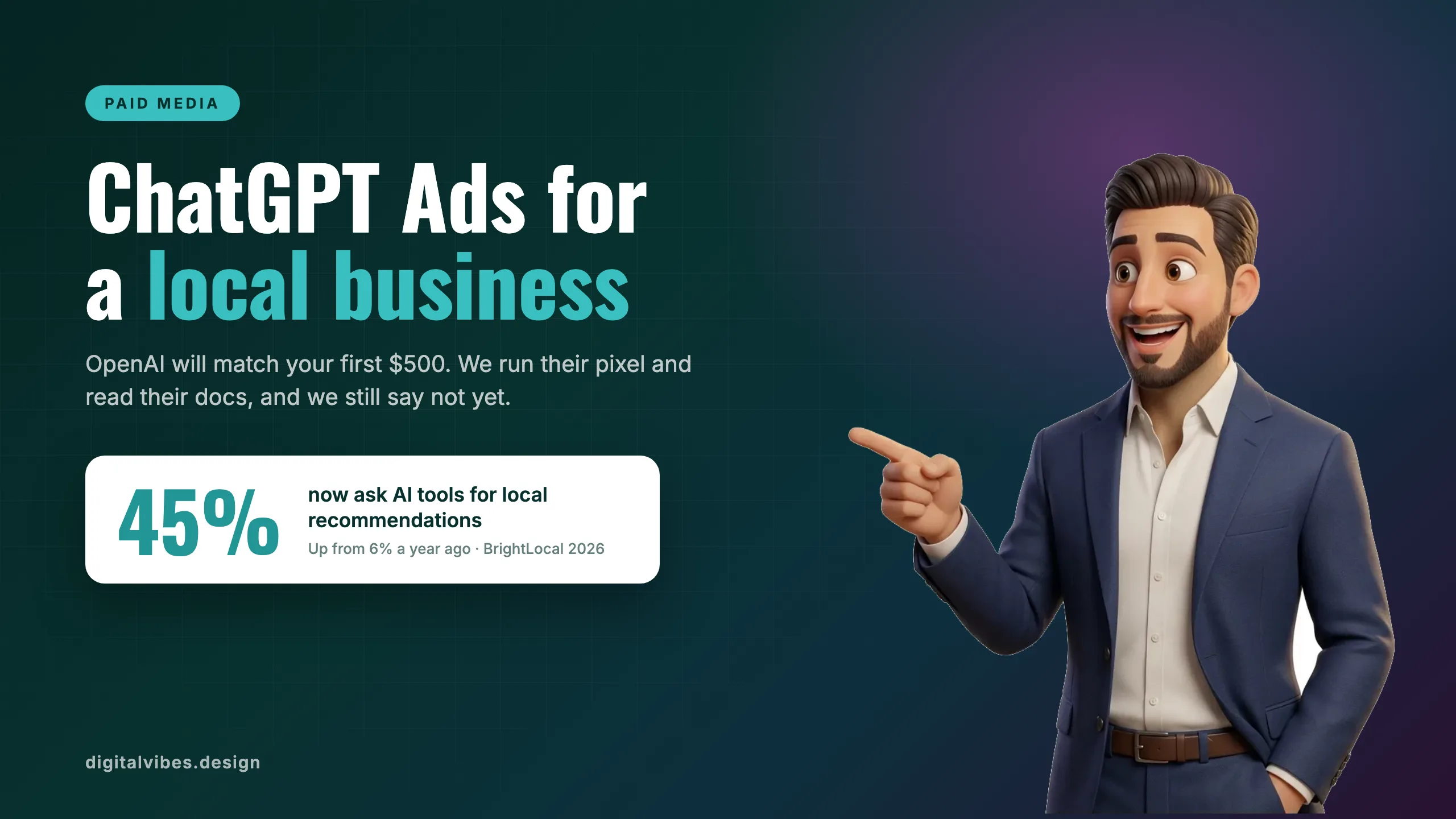
You have probably seen the offer by now: spend your first $500 on ChatGPT Ads and OpenAI matches it with another $500. If you run a local service business, our answer is no, not yet. Take the credit only as tuition if you are curious, cap it at what the credit covers, and do not move a dollar out of local SEO to fund it.
That is not a knock on the idea. People really are asking ChatGPT which plumber to call. It is a judgment about the ad product as it exists today, and it comes from reading OpenAI’s own documentation and from running their pixel and conversions API on this site since September 11, 2026.
Key takeaways
- The ad unit is four fields. OpenAI’s spec: “Advertiser name,” “Favicon,” “Title (headline),” “Landing page.” No phone number, no rating, no hours, no directions.
- Minimum daily budget is $25 per campaign (OpenAI), roughly $760 a month, and OpenAI recommends “a maximum bid of $3–$5 USD per click.”
- Geo-targeting is real now: US state, DMA and ZIP, reported by PPC Land in May 2026. There is still no radius, which is the shape most service areas actually are.
- There is no phone-call conversion event.
lead_createdandappointment_scheduledexist; a ringing phone does not, so the channel cannot optimize toward how the trades actually get hired.- Ads only reach the Free and Go tiers. Plus, Pro, Business, Enterprise and Education users never see them.
- The demand is genuine: use of ChatGPT and similar tools for local recommendations went from 6% to 45% in a year (BrightLocal). That is an argument for being in the answer, not under it.
The offer, and why it exists
New advertisers get “$500 in matching ad credits for $500 in ad spend,” as Marketing Brew reported on August 31, 2026. The same piece covers a rebuilt onboarding flow where you paste a URL and OpenAI’s model writes the campaign for you, which OpenAI’s Zoheb Hajiyani said “can be used to construct a campaign in less than 60 seconds.”
The credit amount has been a moving target. Digiday covered the same push on July 30, 2026 under the headline that OpenAI “reaches the coupon stage of building an ad business,” noting offers as small as a $50 credit for $50 spent inside 14 days, and that “the credit values are still moving around, seemingly while OpenAI works out the right numbers.”
Coupons are what a platform hands out when it needs advertisers faster than advertisers are arriving. That is not sinister, every ad network has done it, but it tells you where the product is in its life. You are being paid to beta test.
The demand is real, and it is not the ads
Here is the part that makes this genuinely tempting rather than easy to dismiss.
BrightLocal’s Local Consumer Review Survey 2026, published February 11, 2026 from 1,002 US adults, found that “use of ChatGPT and other generative AI tools for local recommendations has grown rapidly, rising from 6% last year to 45%.” Over the same year Google slipped from 83% to 71%. AI tools now sit third, behind Google and Facebook, ahead of Apple Maps and Yelp.
So the audience is there. The question is what you can actually buy in front of them, and that is where it falls apart.
What the ChatGPT ad unit actually is
Straight from OpenAI’s Ads in ChatGPT: The Basics: “Ads appear below ChatGPT responses.” Each ad includes four things. Advertiser name. Favicon. Title, meaning the headline. Landing page.
Read that list again with a plumbing customer in mind. There is no phone number. No star rating. No review count. No hours, no “open now,” no directions, no photos, no service area. A local searcher decides using exactly those things, and none of them are available to you.
Now compare it to what that same person sees when the recommendation comes from Google Maps, or from ChatGPT’s own answer text above your ad.
One surface is a text link. The other is a decision.
What breaks for local specifically
The geo is better than people think, and still the wrong shape. This is worth correcting, because half the advice online is out of date. As PPC Land reported in May 2026, you can target by US state, DMA or ZIP code, set at campaign creation or changed later. Anyone still telling you ChatGPT Ads is nationwide-only is quoting a stale thread. What does not exist is radius targeting, and a service area is a radius, not a tidy list of ZIPs. You can approximate it by entering every ZIP you cover. That is busywork, and the ZIP and DMA granularity is US-only: ads run in 31 countries, but outside the US you are choosing countries, not neighbourhoods.
You can target a ZIP, but you cannot see a ZIP. Reporting in the ChatGPT Ads Manager gives you impressions, clicks, spend, CTR, average CPC, average CPM and conversions. That is the list. There is no geographic breakdown, so you can target fifteen ZIP codes and never learn which ones produced anything. You cannot cut the dead suburb or double down on the one that converts, because the report does not contain the data either decision needs.
You cannot choose your call to action. The available buttons are Shop Now, Book Now, Sign Up and Learn More, and PPC Land reports that “CTAs are automatically selected based on the ad creative and the destination experience.” Advertisers do not pick. A dentist who wants Book Now gets Book Now only if OpenAI’s model agrees.
There is no phone call in the conversion list. This one deserves precision, because it is better than the internet says and still fatal. OpenAI publishes the full event taxonomy, and two entries genuinely fit a local business: lead_created, “A user submits a lead form or requests contact,” and appointment_scheduled, “A user books a meeting, demo, or consultation.” A med spa or a law firm can work with those. What does not exist, anywhere in the list, is a phone call, a click-to-call, a directions request or a store visit. The trades run on the phone ringing, and the platform cannot count it, let alone bid toward it. You can push a call-tracking number in as a custom event, except that OpenAI’s conversion-optimized campaigns doc says “Custom conversion events are not currently supported for conversion-optimized campaigns.” So the workaround measures, and cannot optimize.
If you run the feed campaign, your geo quietly reverts to the whole country. Buried in OpenAI’s campaign targeting doc is one sentence that undoes everything above: “New product-feed campaigns support geographic targeting and exclusions only at country level.” Pick the shopping-catalog campaign type, and your careful ZIP list stops applying. If you have heard people complain that their ChatGPT ads served far outside the target area, this is the likeliest mechanical reason, and we have not found one that warns about it.
The floor is higher than a local budget expects. Minimum daily budget is $25 USD per campaign. Call it $760 a month. OpenAI recommends starting at “a maximum bid of $3–$5 USD per click,” so that floor buys somewhere around 150 to 250 clicks, before you have learned anything about whether they convert.
Paying subscribers cannot see you at all. Ads appear only to users on the Free and Go plans. Everyone on Plus, Pro, Business, Enterprise and Education sees nothing. Nobody publishes the split, so treat the size of that blind spot as unknown. Note the direction of it, though: the people who pay to remove ads skew toward the people who can afford the expensive job.
What we found running ChatGPT Ads ourselves
We wired ChatGPT Ads measurement into this site on September 11, 2026, pixel plus the server-side conversions API. Three things cost us real time and are documented nowhere obvious.
The Ads API key and the Conversions API key are different keys with different scopes, and they are not interchangeable. Posting conversions with the campaigns key returns 401 Missing scopes: ads.third_party_events.write. Nothing in the dashboard says so; you find out by getting a 401 and reading it carefully.
The product feed endpoint is not where you would guess. /v1/product_feeds and /v1/catalogs both return 404. The real one is /v1/feeds.
And on reporting, OpenAI supplies its own warning: “Impressions, clicks, and CTR can appear within minutes. Spend reporting can take longer, so a displayed spend of zero does not necessarily mean no charges have accrued.” Read that carefully, because it cuts the opposite way from the complaint you usually hear. A zero in the spend column is not a free day; it is a column that has not caught up.
Our own impression is that the dashboard and our analytics did not line up cleanly, and we are deliberately not publishing that as a finding until we have run enough spend to put numbers behind it. What we can say is that the instruments are thin and we are not the only ones who want better ones: Marketing Brew reports that marketers have been asking OpenAI for “additional campaign controls and measurement options on the channel.”
Product feeds through Shopify were the other rough edge. Sync is not all-or-nothing, and which items make it through is not obvious from the merchant side. If you sell services rather than SKUs this is moot, and most local businesses reading this do.
The comparison that actually decides it
Put the $760 a month floor next to what the same money does in local search, and the argument stops being about AI at all.
A Google Business Profile optimization is $650 one time. It touches the fields that Whitespark’s 2026 ranking factor study puts at the top of the local pack: primary category, business title, hours, categories, review flow. Those fields are free, they are already sitting in your profile, and they do not stop working when you stop paying.
BrightLocal’s same survey found that 97% of consumers read reviews for local businesses, and that after reading a positive one, 54% go to the business website, 31% visit in person, 20% make contact and 20% book an appointment. Those are the behaviors you are trying to buy. A text link under a chat answer does not participate in them.
There is also the uncomfortable fact that ChatGPT’s recommendation sits above your ad, and it is assembled from what the web says about you: your profile, your reviews, your citations, your pages. Getting named in that paragraph costs nothing per click and does not switch off.
Yelp made that concrete in August 2026. Its integration with ChatGPT puts “Yelp’s trusted reviews, ratings, photos, and business details directly within the chat experience,” with restaurant reservations and waitlists bookable without leaving the conversation. In the same announcement Yelp claims it “is the most cited home services discovery platform, with a 3.4x lead in citations over its nearest competitor across major AI platforms,” and cites its own finding that 65% of people say “being able to take action, such as making a reservation, on trusted platforms is important when using AI tools for local discovery.”
Read that as an advertiser and the conclusion is blunt. The ratings, the photos and the review text that decide whether ChatGPT names you are the exact assets the ad unit will not let you display. You can pay $760 a month for a headline and a link, or you can earn the sentence above it. That work is what SEO for AI search actually is, and it is the same work that wins the map pack. If you want to know which sources that answer is actually built from, we sorted them in which data sources AI search uses.
So when should you revisit this?
Not on a date. On conditions. Here is what we are watching for.
This platform is moving fast, and nothing above is a permanent verdict. Geo-targeting and daily budget controls were both added during 2026, on a product that started the year without either. The gap between “interesting” and “worth your lead budget” is smaller than it looks, and we will update this post when it closes.
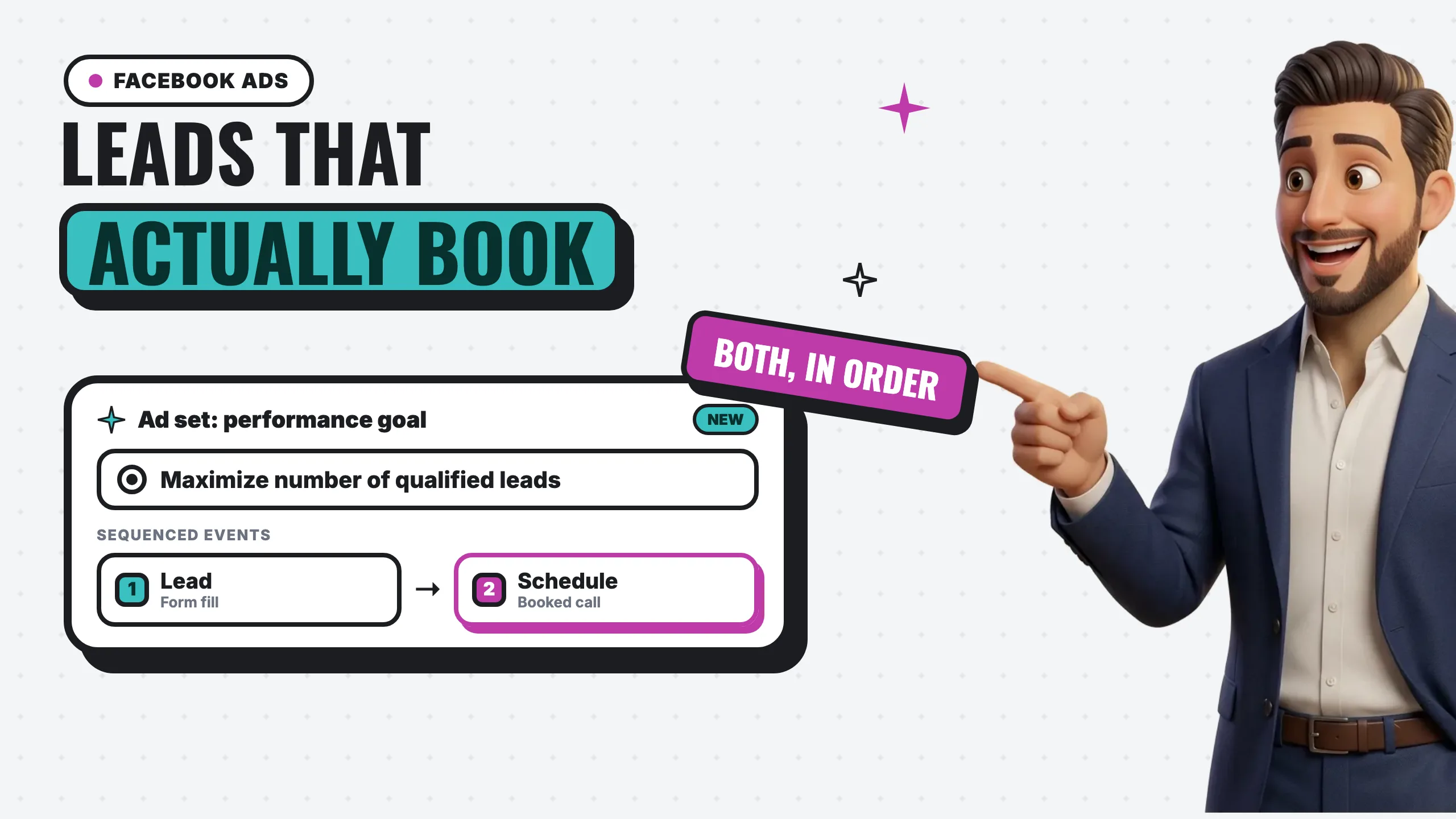
If you want paid leads in the meantime, Meta just added a setting that optimizes for people who fill out your form and book: here is how Facebook’s qualified leads setting works.
Frequently asked questions
Should I take the $500 ChatGPT Ads credit?
Take it if you want to learn the platform, and spend only what the credit matches. Do not fund it by cutting local SEO, do not expect it to produce bookings, and turn it off when the credit runs out. Treat the number it produces as a benchmark for later, not a result.
How do you advertise on ChatGPT?
Through the ChatGPT Ads Manager at ads.openai.com. You give it your website, and it drafts the campaign for you: objective (views, clicks or conversions), a budget at or above the $25 daily minimum, the countries you want, and then US state, DMA or ZIP targeting on top. The call-to-action button is assigned by OpenAI rather than chosen by you. Setup is genuinely fast. Setup being fast is not the same as the channel being ready.
Does ChatGPT Ads have local targeting?
Yes. You can target by US state, DMA or ZIP code, a capability PPC Land reported in May 2026. What it does not have is radius targeting around your shop, which is the shape most service areas take. You approximate it by listing every ZIP you serve, and that granularity exists only in the US.
What does ChatGPT Ads cost?
ChatGPT Ads pricing starts at a $25 USD minimum daily budget per campaign, about $760 a month, and OpenAI recommends a maximum bid of $3 to $5 per click. The auction, in OpenAI’s words, is “a relevance-weighted, second-price auction.”
Why does ChatGPT Ads show zero spend, or numbers that look inflated?
Check them against your own analytics before you trust them. OpenAI’s own documentation warns that “a displayed spend of zero does not necessarily mean no charges have accrued” and that reporting times vary. Tag every landing page with UTM parameters, which persist on ad clicks, and reconcile the two.
How do I show up in ChatGPT without paying for ads?
The same way you show up in the map pack. ChatGPT builds its recommendation from what the open web says about you: your Business Profile, your reviews, mentions on real local sites, and pages that clearly state what you do and where. That is ordinary local SEO, and it also happens to be the only version of this that keeps working after you stop paying.
Is ChatGPT Ads better than Google Ads for a local business?
No, and it is not really competing yet. Every control a local advertiser reaches for first is missing:
| What a local advertiser needs | ChatGPT Ads | Google Ads |
|---|---|---|
| Target a radius around the shop | No, state, DMA or ZIP only | Yes |
| Count a phone call as a conversion | No | Yes |
| Choose the call-to-action button | No, assigned automatically | Yes |
| See results by location | No geographic breakdown | Yes |
| Show a star rating in the ad | No | Yes, via seller and location assets |
| Reach paying ChatGPT subscribers | No, Free and Go tiers only | Not applicable |
| Pay per lead rather than per click | No | Yes, via Local Services Ads |
If you have budget for one paid channel, that comparison is not close.
The bottom line
The interesting number in this whole story is 45%, not $500. In one year, the share of people using ChatGPT and similar tools to pick a local business went from 6% to 45%. Your customers are genuinely in there asking.
They are just not asking to be sold to. They are asking ChatGPT who is good, and ChatGPT answers from the reviews, the profile and the mentions you have or have not built. The ad is a text link underneath that answer, missing every field a local customer uses to choose, priced at a $760 monthly floor, invisible to paying subscribers, and optimizing toward events that are not phone calls.
Take the credit, learn the interface, and put the real money where the answer gets written.
Start with the diagnosis: our free local rank grid audit shows exactly where you rank across your service area, point by point, and what is costing you the top three. If you would rather see the profile side first, the free 60-second GBP scan grades your listing against what is ranking around you, no signup.