Every two years, 47 local search experts sit down and score 187 ranking factors. The 2026 results are out, and for a local business the headline is smaller than the dataset: four fields on your Google Business Profile outrank everything you can buy, reviews moved from bonus to baseline, and the advice everyone gives about posting is right for a reason nobody explains properly.
That last one gets its own section, because Google shipped post view counts on September 10, 2026, and the measurement finally exists. First, what the report is and which of the 187 factors you can actually change.
Key takeaways
- The number one local pack factor is your primary category (score 227), ahead of every paid channel. Google itself says “There’s no way to request or pay for a better local ranking on Google.”
- Four of the top ten factors are fields inside your Business Profile. Two of the top ten are fixed geography you cannot change.
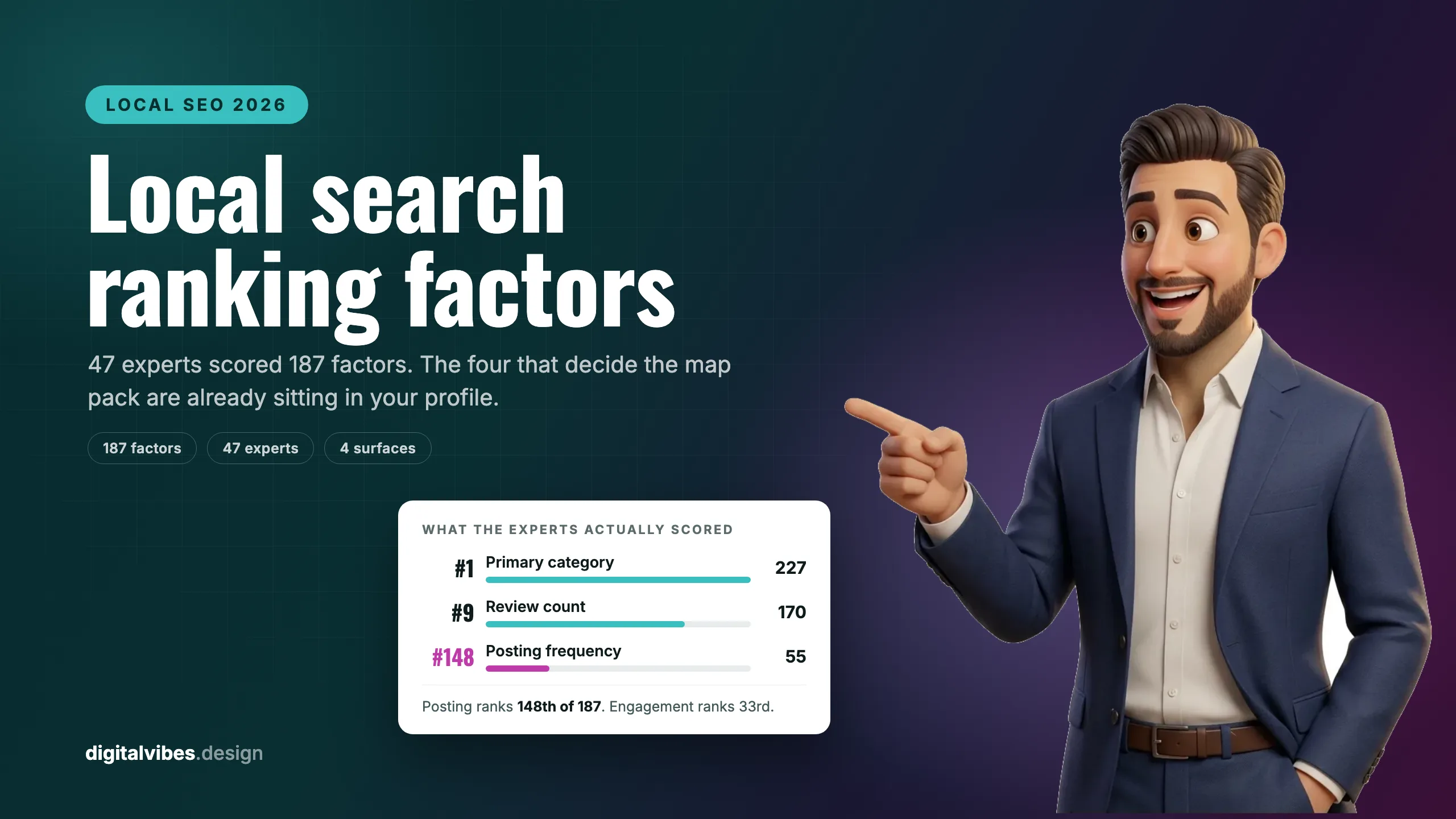
- Engagement signals on your profile rank 33rd and were among the biggest risers this edition, while raw post frequency ranks 148th. Posting is how you supply that engagement, and Google’s new post view counts let you measure it for the first time.
- AI search visibility got its own scoring column for the first time. Darren Shaw’s summary: “In AI SEO, mentions (citations) are the new link.”
- The third strongest ranking factor and the eighth strongest suspension risk are the same field: keywords in your business name.
What this report is
The Local Search Ranking Factors report started with David Mihm in 2008 and has been run by Darren Shaw at Whitespark since 2017. The 2026 edition, published November 6, 2025, surveyed “47 of the best and the brightest local search experts,” each scoring 187 factors from 0 to 5 across four areas: local pack and Maps rankings, local organic rankings, conversion impact, and, new this year, AI search visibility.
Nobody surveyed has access to Google’s algorithm. What the scores represent is the aggregated judgment of people who test local rankings for a living, which is the closest thing the industry has to evidence. The scores you see below (227, 225, and so on) are the summed expert ratings, so they are useful for ordering factors against each other, not as percentages of anything.
Google’s own description of the algorithm is three sentences long and has not changed: rankings come from relevance (“how well a Business Profile matches what someone is searching for”), distance (“how far each business is from the customer who’s searching”), and prominence (“how well-known a business is”). The 187 factors are the industry’s attempt to fill in the detail Google leaves out (Google).
The 187 factors sort into three buckets
Before optimizing anything, sort. Every factor in the report falls into one of three categories, and only one of them is worth your Tuesday morning.
| Bucket | Examples | What to do |
|---|---|---|
| Fixed | Proximity to the searcher (#2), physical address in the city of search (#4), proximity to centroid (#12) | Nothing. Accept it and compete on the rest. |
| Structural | Address showing versus service area (#7) | Decided by how you operate, not by optimization. |
| Controllable | Primary category (#1), business title (#3), hours (#5), ratings (#6), additional categories (#8), review volume (#9), map pin (#10) | This is the work. |
| Noise | Geo-tagged photos (#187), title tag length (#184), keywords in image metadata (#181) | Stop. These score near zero. |
Two of the top ten are pure geography, and a third, whether your address is visible at all, is decided by whether you run a storefront or a service area business. That is not a reason to quit, it is a reason to stop comparing yourself to the business three blocks closer to downtown and start comparing yourself to the ones at your own distance.
Three surfaces, three different leaderboards
The thing most local businesses get wrong is treating “showing up on Google” as one job. It is three, and they reward different work.
Whitespark also asks the experts to estimate how much weight Google gives each group of signals. Those weightings are published as a chart rather than a table, so the percentages below are Advice Local’s reading of it. Treat them as proportions, not decimals.
Your Business Profile is worth roughly four times more in the map pack than it is in the organic list beneath it. Your website is the reverse. And AI search sits between them, closer to the website side.
That is the argument against picking one. A business that only maintains its profile wins three map slots and loses every other query. A business that only writes web pages never appears on the map at all.
What ranks the map pack in 2026
Here is the top ten, with the fixed factors marked so you can see how much of the leaderboard is actually yours.
Seven of those ten are yours. None of them cost money. All of them are fields you can review in about twenty minutes, which is why the free 60-second GBP scan is the honest first step before anyone sells you a strategy.
The four profile fields that outrank everything you can buy
Four entries in the top ten live inside your Business Profile, and they behave less like optimizations and more like settings you either got right or did not.
Primary category (#1, score 227). The strongest single factor in local search. Pick the most specific category that describes the work you want, not the category that describes everything you are capable of. An emergency plumber who selects “Plumber” is competing in a broader, more crowded contest than necessary. Getting this wrong is not neutral, it is the second strongest negative factor in the report (“Incorrect Primary Category,” score 214).
Business title (#3, score 223). Keywords in your business name rank third. They are also the eighth most common suspension risk (“Keyword Stuffing in GBP Business Name,” score 125). Both are true at once. Use your real, legally operating name, including a descriptor if that descriptor is genuinely part of your name on your signage and paperwork. Inventing “Salinas Emergency Plumbing Repair 24/7” because the survey says keywords rank is exactly the behavior that gets a listing pulled.
Hours (#5, score 189). Being open at the moment someone searches is brand new to the survey this edition and went straight to number five. Shaw describes watching it happen live: “When your business is open you can be sitting pretty at #1 in the local results, and then 60 minutes before you close you’ll start to drop off, and then when you’re actually closed you’ll be displaced by businesses that are open.” A separate factor, “Proper Hours Set on GBP,” rose 64 places this edition, from 85 to 21. “No Hours of Operation on GBP” is the eighth strongest negative factor (141). Holiday hours count. So do the special hours you set once in 2024 and forgot.
One warning attached to that finding, because the obvious hack is already circulating: Shaw notes some businesses are listing themselves as open 24/7 to farm ranking time. If you are appointment-only with a call answering service, fine. If you are a storefront where someone might actually show up at 9pm, you have traded a ranking bump for a one-star review, and it is against Google’s guidelines either way.
Additional categories (#8, score 173). You get one primary and up to nine secondary. Fill them with categories you actually serve, and only those. “Category Confusion,” meaning secondary categories from unrelated industries, is its own negative factor (125).
Underneath the top ten, the services section is the sleeper. Presence of GBP Predefined Services entered the survey as a new factor this edition and landed at #22 (134). Keywords in GBP Services climbed 75 places, the single largest rise in the report, from 110 up to the mid-thirties. Shaw’s note on it: “Yep, services impact rankings.” Most profiles we open have that section empty.
Reviews stopped being a bonus
Darren Shaw’s own summary of what changed: “the biggest changes we’re seeing are an increased importance of review signals and behavioural signals.”
Reviews now occupy four positions inside the top 15 local pack factors, and they behave as four separate dials, not one:
| Factor | Local pack rank | Score |
|---|---|---|
| High numerical Google ratings (4 to 5) | #6 | 181 |
| Quantity of native Google reviews with text | #9 | 170 |
| Recency of reviews | #11 | 164 |
| Sustained influx over time, rather than bursts | #14 | 154 |
That fourth row is the one that changes behavior. A business that collects forty reviews in one campaign and then stops scores worse on this factor than a business that collects three a month forever. “Receiving Too Many Google Reviews Too Fast” also appears on the suspension risk list (#12). The mechanism you want is a habit, not a push, which is the whole argument of how to get more Google reviews.
Then look at the conversion column, where reviews stop being a ranking question and become a revenue one. High Google ratings are the number one conversion factor in the entire report (213), with positive sentiment in review text at number two (179). Ranking gets you seen. Ratings get you chosen.
One caution, straight from the myth list: “Keywords in Owner Responses to Reviews” scores 28 out of 187, near the very bottom. Reply to every review, because 2026 consumers expect it and because it is visible to the next reader. Do not write your replies for the algorithm. More on the mechanics in how to respond to Google reviews.
Posting, and what it actually moves
This is the part we run ourselves, every single day. A job takes the next article we have shipped and pushes one post to our Google Business Profile, one per run, on purpose, because dripping a backlog out over weeks reads better on a listing than dumping it in an afternoon. It is one of the first systems we put in place on a client profile, alongside the categories and the review habit, and we keep it there because profiles that stay active behave differently from profiles that go quiet.
The 2026 survey explains why it works, and the explanation turns out to be more useful than the tactic.
Taken alone, the posting rows look discouraging. Frequency of Google Posts sits at #148 in the local pack column (score 55), sheer quantity of them at #168. Read those rows next to the one above them and they say something completely different: “Quantity of Engagement Signals on GBP” sits at #33, and the report names it among the factors that gained the most importance this edition.
Shaw spells out what those engagement signals actually are, and posts are on the list. Engagement, in his words, is “real humans engaging with your GBP … by dwelling on it, looking through your photos, reading reviews, watching videos, and reading your posts,” and it “will definitely help you improve your rankings.” His conclusion is the one we would have written ourselves: “Give people content to engage with, and the algorithm will reward you. But even better than the algorithmic benefits: you’ll drive more conversions.”
So posting is not a box you tick 52 times a year, and the #148 is not a verdict on the habit. Posting is the supply side of the strongest behavioural signal on your profile. A listing with nothing on it gives people nothing to dwell on, nothing to open, nothing to react to, and the factor sitting at #33 stays empty. That is why the cadence works. Not because Google counts your posts, but because people read them.
Google just made this measurable
Until September 2026, everything above had to be taken on faith. In the Small Business Bulletin published on September 10, Google announced Google Posts Reporting “directly inside your Google Business Profile dashboard,” so you can now “see exactly how many times local customers viewed your posts, taking the guesswork out of which offers and updates resonate best with your audience” (Google).
What it gives you, in Google’s own terms:
- Rolling 18-month insights. “Review performance metrics across posts published over the past 18 months.”
- All post types. Views across “regular updates, special offers and events.”
- Cross-platform reach. “Aggregated views from customers discovering your business on both Google Search and Google Maps.”
To find it: sign in to your Business Profile, select Posts from the dashboard menu, and look for the view count on each post card. Google notes it is “Currently rolling out globally, not yet available in the API,” so if it has not reached your dashboard yet, it is on the way.
This is the number to run your posting on, and it is the first time a local business has had it. Not how many posts you published, which the survey scores at #148, but how many people actually looked, which is what feeds the signal scored at #33. Run the offer that pulled views again. Retire the format that pulled none. That is the difference between posting as a chore and posting as a channel, and eighteen months of history means you can see your own pattern the day the feature lands.
Keep the listing current regardless: Google archives posts older than six months (Google), so a profile with nothing recent looks abandoned to the one audience that always matters, the person deciding whether to call you.
One related finding in the expert commentary is worth sitting with, from Claudia Tomina: “Popular Times real-time data has a measurable impact on rankings. If your location is busier than usual, there’s a strong chance you’re also ranking higher at that moment.” Real activity, not published activity.
Your website still decides the organic half
The map pack is three results. Below it is the local organic list, which is a different contest with a different leaderboard, and it is the half that most local businesses ignore because the profile feels like the whole job.
The top of the 2026 local organic list:
- Dedicated page for each service (210)
- Geographic keyword relevance of content (190)
- Quality and authority of inbound links to the domain (187)
- Keywords in the GBP landing page title tag (179)
- Quantity of inbound links from industry-relevant domains (175)
- Internal linking across the entire website (174)
Read the first two together and you have the entire content strategy for a local business: one page per service, and those pages say where you work. Not one “Services” page listing eight things. Eight pages. Each naming the city or neighborhood in the copy, because that is the second strongest organic factor in the report.
Number six is the one nobody does. Internal linking across the whole site scores 174, higher than most link-building tactics, and it costs nothing but attention. If your drain cleaning page does not link to your water heater page, you are leaving a top-six factor on the floor. Our web crawler lesson shows why: links are how Google finds your pages in the first place.
This is also where the myth list earns its keep. “Length of Title Tag” ranks 184th out of 187. Shaw’s comment is worth quoting in full: “TITLE TAG LENGTH IS AN SEO MYTH. You do not need to worry about making sure your title tags are 60 characters.”
The new column: AI search visibility
For the first time, every factor also got scored on its impact in AI answers, the ChatGPT, Gemini, and AI Overviews layer. The top five look nothing like the map pack list:
| Rank | AI search visibility factor | Score |
|---|---|---|
| 1 | Presence on expert-curated “best of” lists | 179 |
| 2 | Dedicated page for each service | 170 |
| 3 | Prominence on key industry-relevant domains | 167 |
| 4 | Quality of unstructured citations (news, blogs, gov, associations) | 160 |
| 5 | Authority of third-party sites where your reviews appear | 156 |
Three of those five are citations, which is the finding Shaw calls out directly: “In AI SEO, mentions (citations) are the new link.” Citations had been declining in value for a decade. AI search revived them, because a language model builds its picture of your business from places that talk about you, not from links pointing at you.
What that means for a local business, concretely:
- Get into the local “best of” lists. The independent ones, the chamber roundups, the “top 10 X in [your city]” posts. This is petitioning, not optimizing, and it is slower than everything else on this page.
- Claim the directories that matter in your trade, and fill in every field rather than just the name and phone.
- Collect reviews somewhere other than Google. The authority of third-party review sites is a top-five AI factor. Google-only is now a single point of failure.
- Keep the site scannable. “Scannable Content Structure Across Entire Website” made the AI top ten at #10, and never cracked the top 100 for the map pack. Headings and lists are now a retrieval feature.
One honest caveat on this column, which Shaw raises himself: scoring a factor for “AI search” is ambiguous when the platforms have different access to data. Google’s own AI surfaces can read your Business Profile. ChatGPT cannot. Treat this list as direction, not as a dial.
The myths: stop doing these
These are the ten lowest-scoring factors out of 187. If something on this list is on an agency’s proposal to you, ask why.
| Factor | Score (out of 187 ranked) |
|---|---|
| Presence of geo-tagged photos | 23 (last) |
| Follower count on social profiles | 25 |
| Participation in Google Ads or other paid Google products | 26 |
| Length of title tag | 26 |
| Presence of XML sitemap | 28 |
| Keywords in owner responses to reviews | 28 |
| Keywords in image metadata fields | 30 |
| Quantity of posts on social profiles | 32 |
| Keywords in meta descriptions | 33 |
| Frequency of posts on social profiles | 34 |
Geo-tagging photos before uploading them to your profile is dead last out of 187 factors, and it is still sold as a service. Paying for Google Ads does not help your organic pack position, which matches Google’s own statement that there is no way to pay for local ranking. And social posting volume appears twice in the bottom ten, which is a different claim from “social media is useless”: it is useless as a local ranking factor.
The things that actively hurt you
Ranking factors get the attention. The negative list is faster to fix and usually more profitable, because these are conditions, not projects.
| Rank | Negative factor | Score |
|---|---|---|
| 1 | Business marked as permanently closed | 217 |
| 2 | Incorrect primary category | 214 |
| 3 | Another profile in the same category at the same address (the filter) | 188 |
| 4 | Low ratings (1 to 2 stars) | 168 |
| 5 | Business marked as temporarily closed | 166 |
| 6 | Incorrectly placed map marker | 164 |
| 7 | Site hacked or serving malware | 164 |
| 8 | No hours of operation on the profile | 141 |
Numbers one and five are worth a five-second check right now, because they are usually not your doing. Google accepts edits from the public and from data partners, and a competitor or a confused customer marking you closed is a known failure mode. If you have ever wondered why the phone stopped, start there, then work through the reasons a business stops showing up on Google.
Number three, “the filter,” catches multi-practitioner offices and shared addresses. Two profiles in the same category at the same address means one of them gets filtered out of the pack. It is not a penalty, it is deduplication, and it is solved by differentiating categories or addresses, not by appealing.
What gets a profile suspended
Different list, higher stakes. A suspension takes your listing down entirely while you appeal.
The top four are all identity problems: a PO Box, mailbox store, or virtual office address (202), a profile attached to a suspended Google account (194), reports of violations on your profile (167), and association with other suspended listings (152). Then come the ones people do to themselves: review gating (134), meaning filtering customers so only the happy ones get asked, fake reviews (132), and keyword stuffing in the business name (125).
One field-level warning before you touch any of this. Shaw reports that hiding a street address does not always cost rankings, but when it goes wrong it goes badly wrong, because Google can lose the location’s coordinates and re-place the pin on a guess. He describes a case where a business was dropped 200 miles north into the desert and its calls went to zero. If you are a service area business and you have to remove the address, verify afterward where your pin actually landed.
Put the ranking list and the suspension list side by side and the pattern is hard to miss. Keywords in your business name rank third. Faking them ranks eighth on the suspension list. Showing a real street address ranks seventh. Showing an address you do not actually staff, as a service area business, is the eleventh most common suspension trigger.
The strongest factors and the biggest risks are the same fields. The difference between the two lists is not tactics, it is whether the thing you are claiming is true. That is not a moral point, it is the most practical takeaway in the whole report: the highest-leverage local SEO work is making your profile accurately specific, and the fastest way to lose everything is making it inaccurately specific.
What we would do in the first 30 days
Ordered by score, not by effort.
- Check that you are not marked closed and that your map pin drops on your actual door. Ten minutes, top-six negative factors.
- Re-pick your primary category. Look at what the three businesses above you use. This is factor number one and negative factor number two in the same breath.
- Fill all nine secondary categories with services you truly offer, then fill the services section, which most profiles leave empty.
- Fix hours, including holiday hours. Top-five factor, top-eight negative factor.
- Start a review habit, not a review campaign. Three a month beats thirty once, by the report’s own scoring. Reply to all of them, without keywords.
- Build one page per service, each naming the cities you serve, and link them to each other. The top two organic factors and the number six factor, in one project.
- Get listed on two local “best of” lists and two trade directories. The slowest item here, and the top AI visibility factor.
- Delete the geo-tagging step from whatever process you inherited.
Items one through four are an afternoon. They are also, on the survey’s numbers, worth more than most of what gets sold as local SEO.
Frequently asked questions
Is the primary category really more important than reviews?
For map pack position, yes. The primary category scores 227 against 181 for high ratings and 170 for review count. For conversion, reviews win outright: high ratings are the number one conversion factor in the report at 213. You need the category to get seen and the reviews to get picked.
Does posting on Google Business Profile help rankings at all?
Yes, through engagement rather than through volume. Raw post frequency ranks 148th of 187, but engagement signals on the profile rank 33rd and were among the biggest risers this edition, and the report’s author lists “reading your posts” as one of those engagement behaviours. An active profile gives people something to engage with; an empty one does not. Since September 10, 2026, Google’s post view counts let you measure exactly that.
Do citations still matter in 2026?
More than they did last year, for a new reason. Whitespark has tracked citations declining as a traditional ranking factor for a decade, but three of the top five AI search visibility factors are citation factors. Mentions of your business on real third-party sites are how AI answers learn you exist. It is also why buying ChatGPT Ads is the expensive way into that answer: the ad sits below the recommendation, and the recommendation is built from citations.
Should I put keywords in my Google Business Profile name?
Only the ones that are genuinely part of your business name. Keywords in the title rank third out of 187, and keyword stuffing in the title is the eighth most common suspension risk. Same field, opposite outcomes, decided entirely by whether the name is real.
How long until any of this shows up?
Google states that “rankings for new businesses can take up to a month to appear in search results” (Google), and everything above it moves in weeks, not days. The factors that reward consistency, review recency and sustained influx among them, cannot be rushed by design.
The bottom line
187 factors, 47 experts, and the actionable part fits on an index card: get the primary category exactly right, keep your hours and address honest and current, collect reviews steadily forever and answer all of them, build one page per service that names where you work, and get mentioned on real local sites. Everything else on the list is either geography you cannot move or noise near the bottom of the ranking.
The uncomfortable half of the 2026 data is that the fields deciding the whole contest are free, take an afternoon, and are already sitting in your profile unfinished, while plenty of budget goes to things in the bottom third of the list. Posting is the one people misread: judged as raw volume it scores poorly, judged as what feeds profile engagement it is doing real work, and Google’s new post view counts finally let you tell the two apart.
Start with the diagnosis: our free 60-second GBP scan grades your profile against what is ranking around you, no signup. If you want the list above executed rather than explained, the $650 one-time optimization fixes the profile side, and the $550 a month plan keeps the review habit, posting, photos, and local content running. For the map-pack mechanics specifically, how to rank higher on Google Maps covers the three dials in detail.