A customer types “who’s the best plumber in Salinas for a water heater?” into ChatGPT. A few seconds later they get a short answer, two or three business names, and a row of small source links. It looks like one quick step. It’s actually six.
Every AI answer engine, from ChatGPT to Gemini to Google’s AI Overviews, runs a version of the same process: it retrieves information, evaluates which sources are useful, synthesizes a response, and decides which sources to cite. Your business can be included or left out at each of those steps, and each one has a different fix.
Here’s how AI search works, step by step, and what each step means if you run a local business.
Credit where it’s due. This post is built on Semrush’s research, especially their graphic “How AI systems generate answers” and Alex Lindley’s guide AI search strategy: 4 layers of brand visibility, published October 23, 2026. Semrush did the research. We added the small business version: what each step looks like for a shop, a contractor or a clinic, and what to check first.
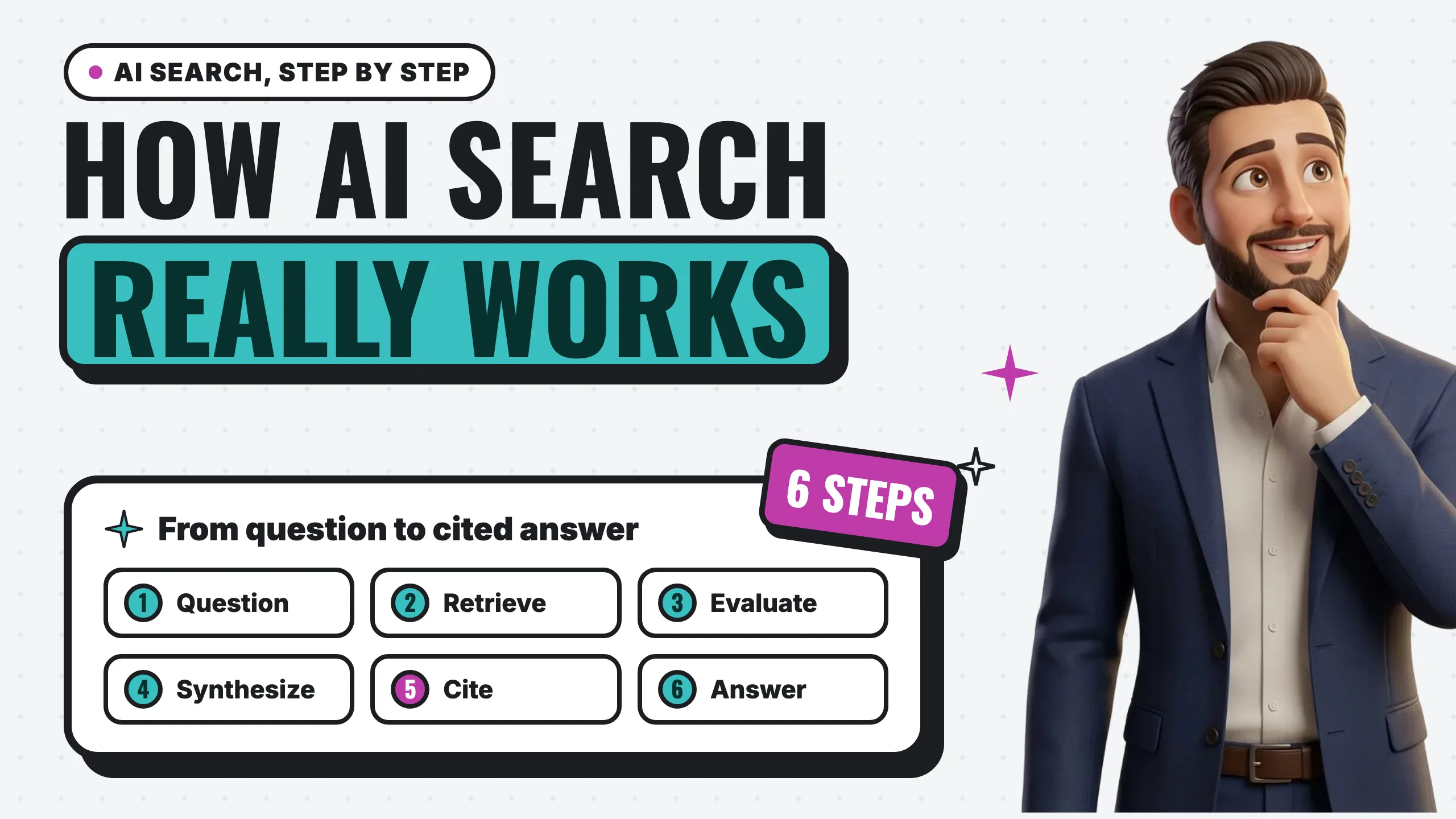
The short answer: AI search works in six steps. Someone asks a question, the AI retrieves pages and data related to it, evaluates which sources are relevant and trustworthy, synthesizes them into one response, decides which sources to cite, and shows the final answer with links. A business needs to be reachable at step 2, described accurately at step 4, and backed by other sources at steps 3 and 5.
Step 1: Someone asks a question
AI search starts with a question in plain language, often longer and more specific than a Google search. Instead of “plumber Salinas,” people tend to type the whole situation: the problem, the town, sometimes the budget or the deadline.
That matters because the AI isn’t matching a keyword. It’s trying to answer the whole question. A page that says “we do plumbing” answers less of it than a page that says “we install and repair tank and tankless water heaters in Salinas, Marina and Monterey, with same-day service.”
What it means for you: write your service pages the way customers describe their problem. One clear page per service, with the towns you serve in plain words.
Step 2: The AI retrieves information
Before it writes anything, the AI goes looking. It searches for pages, listings, reviews and documentation related to the question. Google says both AI Overviews and AI Mode may use a technique it calls “query fan-out,” “issuing multiple related searches across subtopics and data sources” to build one response (Google Search Central). So one customer question can turn into several searches behind the scenes.
This is the step where a business can drop out without knowing it. If the AI’s crawler can’t reach your page, your page can’t be part of the answer. Two rules are worth knowing:
- Google: to be eligible as a supporting link in AI Overviews or AI Mode, “a page must be indexed and eligible to be shown in Google Search with a snippet.” Google adds: “There are no additional technical requirements” (Google Search Central).
- ChatGPT: OpenAI’s search crawler is called OAI-SearchBot. “Sites that are opted out of OAI-SearchBot will not be shown in ChatGPT search answers,” and OpenAI recommends allowing it in your robots.txt (OpenAI Crawlers).
For where the AI looks once it’s out there (Google Maps, Yelp, Reddit, your own site), see our interactive map of where AI gets its information and the tier-by-tier guide to which data sources AI search uses. If retrieval itself is new to you, what is RAG explains the “find first, then answer” idea in plain terms, and what is a web crawler covers the bots doing the finding.
What it means for you: make sure Google can index your important pages, and that your robots.txt, hosting or firewall isn’t blocking the AI crawlers you want.
Step 3: It evaluates which sources to use
Retrieval brings back far more than the AI can use. Next it has to judge which ones to use. Semrush’s graphic describes three tests: relevance (does it match the question?), credibility (is the source trustworthy?) and usefulness (does it add what the answer needs?).
Semrush tested what separates pages AI cites from pages that only rank. Their study compared 304,805 URLs cited by ChatGPT Search, Google AI Mode and Perplexity with 921,614 URLs ranking on Google, between July 15 and August 6, 2025. Cited pages scored higher on five content qualities (Semrush):
| Content quality | How much higher cited pages scored |
|---|---|
| Clear summarization | +32.83% |
| E-E-A-T signals (experience, expertise, authoritativeness, trustworthiness) | +30.64% |
| Q&A format | +25.45% |
| Section structure | +22.91% |
| Lists, tables and Q&A pairs in the text | +21.60% |
That last row is about lists and tables on the visible page, not schema code. Semrush says so directly.
What it means for you: put the answer near the top of each page, show who’s behind the work (real photos, a real name, years in the trade), and use headings, short lists and a simple table where they make things easier to read. Our guide to getting AI to recommend you goes deeper on E-E-A-T and information gain.
Step 4: It synthesizes one answer
Now the AI combines the sources it kept into a single response. This is where your business gets described: what you do, where, for whom, at what price.
The catch is that the AI builds that description from every source at once, not just your website. Semrush puts it plainly: “A brand described inconsistently across the web gets described inconsistently in AI answers.” If your website says you’re open Saturdays, your Google Business Profile says you’re not, and an old directory listing still shows your previous phone number, the AI has to pick one, and it may pick wrong.
AI tools can also fill gaps with a likely-sounding guess. Google’s own guidance on AI content warns that generative models “predict a likely sequence of words” rather than retrieve facts, which is why we wrote about fact-checking AI content before you publish it.
What it means for you: pick one source of truth for your name, address, phone, hours, services and prices. Match your website and Google Business Profile to it first, then fix the outside listings that disagree.
Step 5: It decides which sources to cite
Alongside the answer, the AI picks which sources to show as links. A citation is not the same as a mention, and the difference is bigger than most people expect.
In a study with Kevin Indig, Semrush logged 3,981 domain appearances for 115 prompts across 14 countries on ChatGPT, Google AI Overviews, Gemini and Google AI Mode. In 62% of cases the brand was cited as a source but never named in the answer. The platforms behave very differently (Semrush):
| Platform | Cited as a source | Named in the answer |
|---|---|---|
| ChatGPT | 87% | 20.7% |
| Gemini | 21.4% | 83.7% |
Those source links are often called LLM citations, and they behave differently on each platform. ChatGPT tends to link to you without saying your name, and Gemini tends to say your name without linking to you. Neither one is “the score.” Both count.
The sources the AI cites are also often not yours. Semrush notes that a brand can be named in an answer “while the citation points somewhere else entirely,” like a review site or a Reddit thread. That’s why reviews and mentions on other sites carry so much weight: they’re the independent proof that what you say about yourself is true.
What it means for you: keep earning reviews on Google and Yelp, and get mentioned by local sources people already trust, like your chamber of commerce, a local news story or an industry association.
Step 6: The final answer
The customer sees a short answer and a list of sources. Then they might ask the same question tomorrow and get a different one.
AI answers change from run to run, from platform to platform and from month to month. Semrush tracked one big swing in 2025: ChatGPT cited Reddit in close to 60% of responses in early August and around 10% by mid-September (Semrush). Over a few weeks, ChatGPT’s answers as a whole leaned on very different sources.
What it means for you: one search tells you very little. Check the same handful of questions every month, on more than one AI tool, and watch the pattern.
Where a business can drop out, and what to check
Semrush groups the ways brands go missing into four layers. Here’s how they line up with the six steps, translated for a local business:
| Layer | The step it affects | What it looks like | What to check |
|---|---|---|---|
| Discoverability | Step 2: retrieve | AI never finds your pages | Google indexing, robots.txt, hosting or firewall blocks |
| Clarity | Step 4: synthesize | AI describes you wrong (old hours, wrong services, wrong town) | Website and Google Business Profile match, outside listings agree |
| Authority | Steps 3 and 5: evaluate and cite | AI lists other businesses for your service but not you | Service page depth, local mentions, original info only you have |
| Trust | Steps 5 and 6: cite and answer | AI mentions you but recommends someone else, or adds a caveat | Review count, recency and replies, consistent claims |
Semrush’s advice is to start with discoverability, because the other three only matter once the AI can reach your information. Then let what you see decide the next layer, instead of rewriting your whole site by default.
A 30-minute check you can do this week
- Search your own business in Google. Type
site:yourdomain.comand confirm your main service pages show up. If one is missing, it may not be indexed; confirm it with the URL Inspection tool in Search Console, because AI Overviews only link to indexed pages. - Open yourdomain.com/robots.txt. Look for lines that block
Googlebot,OAI-SearchBotorPerplexityBot. If you’re unsure what you’re looking at, ask whoever built your site. - Ask three AI tools the question your customers ask. Try “best [your service] in [your town]” in ChatGPT, Gemini and Google’s AI Mode. Write down who gets named, who gets linked, and whether anything said about you is wrong.
- Compare what the AI says with the facts. Hours, services, service area, phone. Every mismatch points to a page or listing to fix.
- Do it again next month with the same questions, so you’re watching a trend instead of a single run.
What we do on our own site
We hold our own site to the same checklist. Our robots.txt lets every crawler in, and it names OAI-SearchBot, GPTBot, ChatGPT-User, ClaudeBot and PerplexityBot one by one, so the AI search tools behind ChatGPT, Claude and Perplexity can reach every public page. The only folders closed to them are our admin area and our internal API, which no customer needs to see.
Frequently asked questions
How does AI decide which sources to cite?
It evaluates retrieved pages for relevance to the question, credibility of the source and usefulness to the answer, then shows the sources it leaned on. Platforms differ a lot: in Semrush’s study, ChatGPT cited a brand in 87% of its appearances but named it in only 20.7%, while Gemini did the reverse.
Is AI search the same as Google search?
No, but they’re connected. Google’s AI Overviews and AI Mode only link to pages that are indexed in Google Search and eligible for a snippet, so regular SEO is the foundation. ChatGPT runs its own search crawler, OAI-SearchBot, which you allow or block in robots.txt. For the classic side, see how Google Search works.
Do I need schema markup or an llms.txt file to show up in AI answers?
Neither one is a switch. Google says there are no additional technical requirements for AI Overviews and AI Mode, and Semrush lists treating schema or llms.txt as “citation switches” as a common mistake. Schema still helps machines read your business details when it matches what’s on the page.
Why does ChatGPT give a different answer every time?
Answers are generated fresh each time, and the sources they draw on shift. Semrush measured ChatGPT’s Reddit citations falling from close to 60% of responses to around 10% in about six weeks in 2025. Track the same questions over time instead of judging one answer.
The bottom line
AI search isn’t magic and it isn’t random. It finds information, judges it, combines it, and shows its sources. A local business shows up when it’s easy to find, described the same way everywhere, and backed up by people other than itself.
Thanks to Semrush and Alex Lindley for the research behind this. Their full guide goes deeper on measurement for larger brands.
Want a head start? Our free GBP scan grades the listing that feeds Google Maps, our SEO, AEO and GEO service covers steps 2 through 5, or chat with Echo about what to fix first.