
Your next customer might not start with a Google search at all. They’ll ask ChatGPT, Gemini or Google’s AI Mode for “a good plumber in Salinas,” and the AI will name two or three businesses. In BrightLocal’s 2026 Local Consumer Review Survey, 45% of US consumers said they’d used AI tools for local business recommendations, up from 6% the year before.
So where does AI get its information? Here’s the short version: AI is picking its sources. It reads what’s already out there about your business and your trade, and it repeats what it trusts.
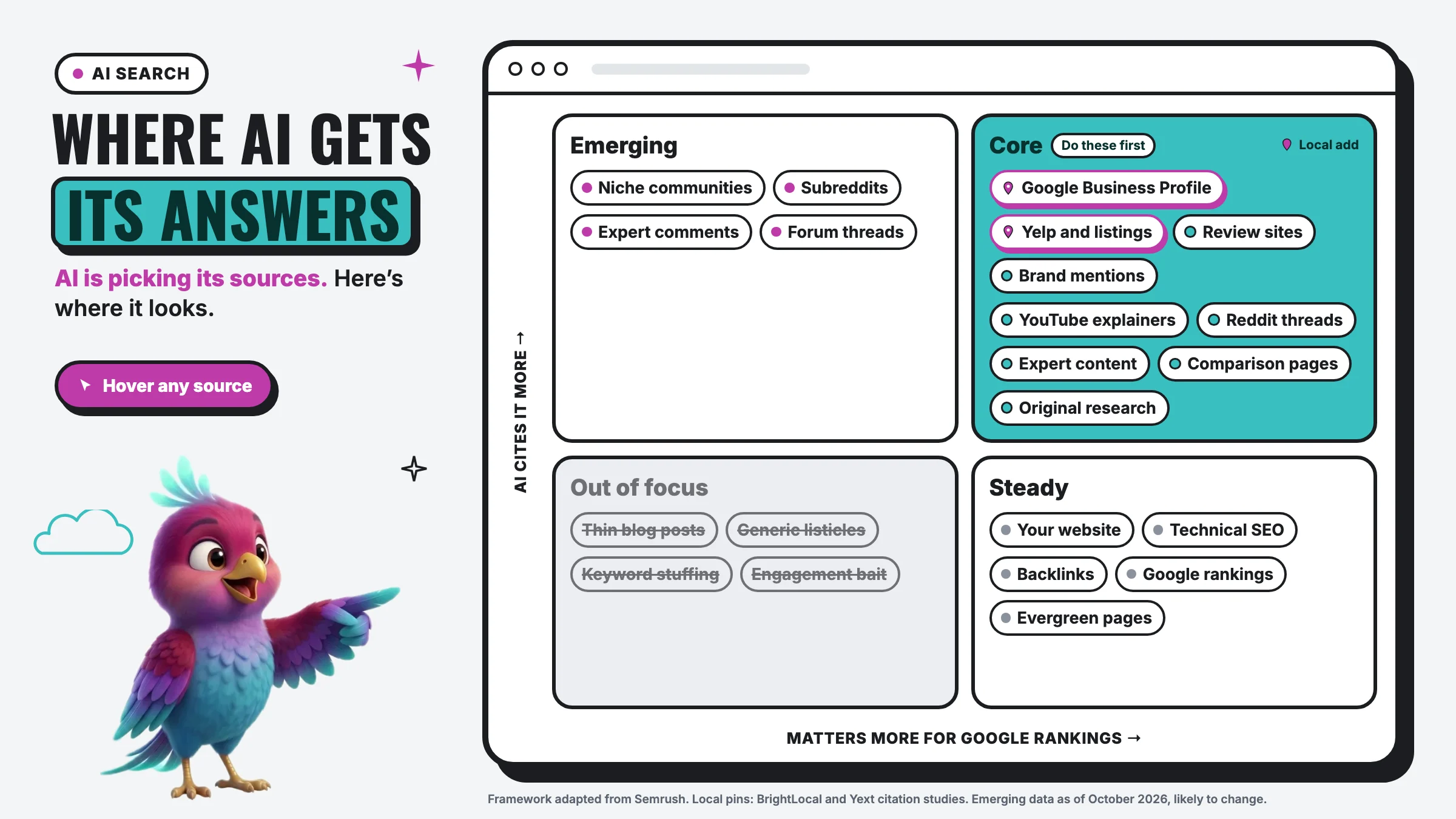
The chart above is my take on one Semrush shared, called “Where AI actually gets its answers.” It asks two questions about every kind of source:
- Up the side: how likely is AI to cite it?
- Along the bottom: how much does it matter for traditional Google rankings?
I redrew it and added two pins for local businesses, because the original leaves out the two sources that matter most for a plumber, a detailer or a salon. More on those below.
This is emerging data. AI search is new and changes month to month. Every number below was checked against its source in October 2026, and some of them will likely shift as ChatGPT, Gemini and Google change how they pick sources. Treat this as a snapshot, not a rulebook.
How to read the map
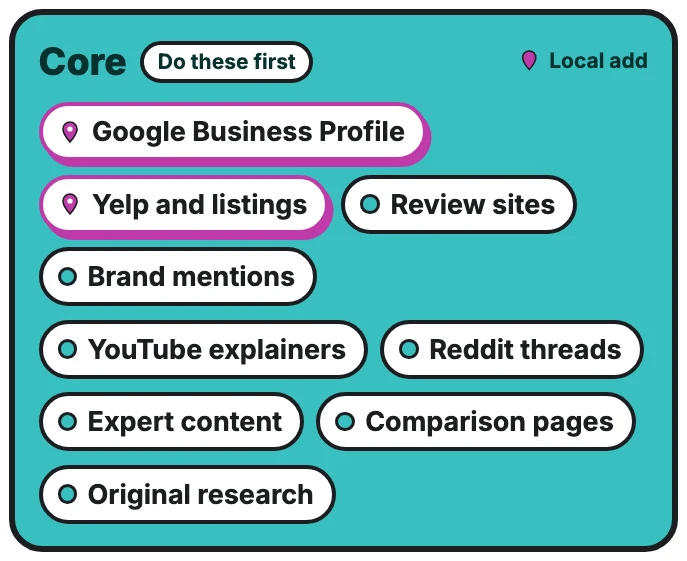
- Core (top right): AI cites it and Google values it. Do these first.
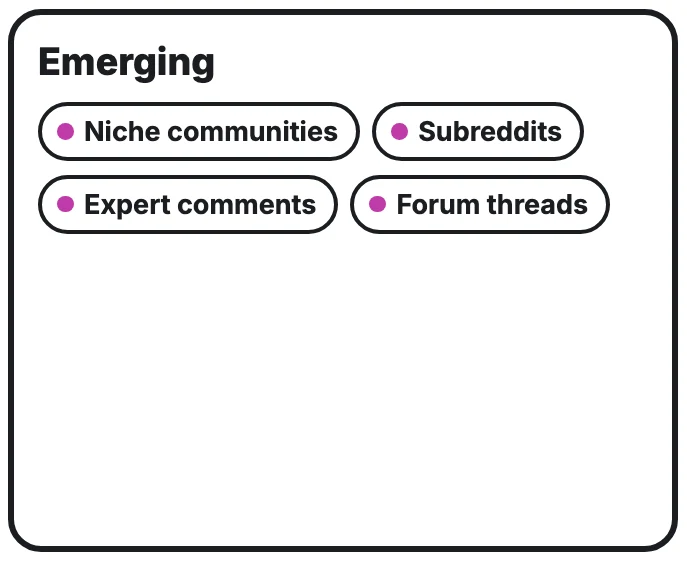
- Emerging (top left): AI cites it, but it does little for your Google rankings.
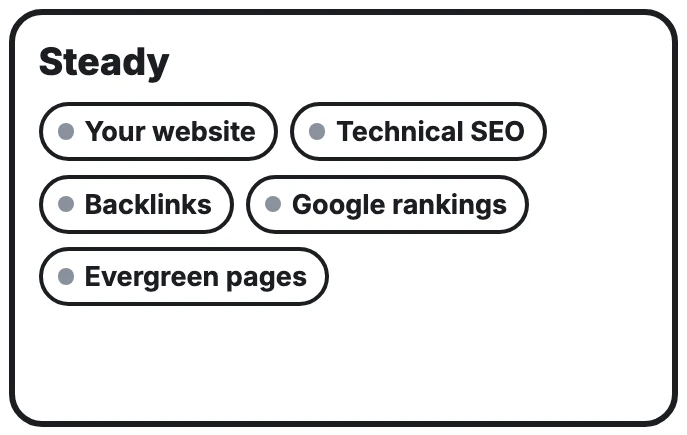
- Steady (bottom right): it still matters for Google, and AI cites it less.
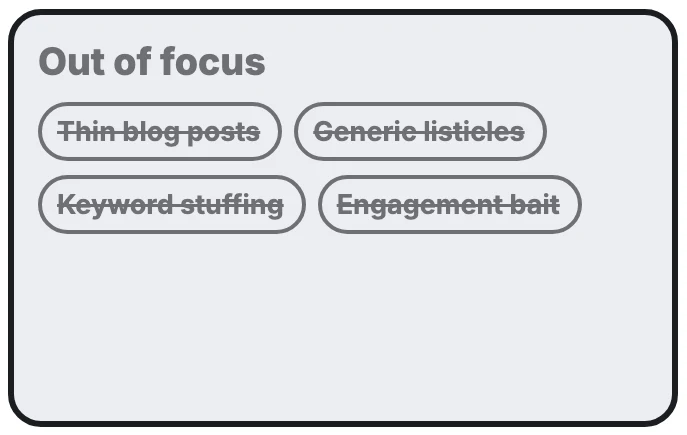
- Out of focus (bottom left): low value for both. Skip it.
Core: where AI and Google agree
Everything in the Core box has one thing in common: it’s other people, or real proof, saying who you are and what you do.
Reviews: what customers write about you is exactly what AI summarizes. And people check. BrightLocal found 97% of people who use AI for recommendations sometimes double-check them against real reviews. Our guide to getting more Google reviews covers the ask and the follow-up.
Brand mentions: your business named in local news, a supplier’s page, a chamber listing or a “best of” article. In Ahrefs’ study of 75,000 brands, branded web mentions correlated strongly with AI visibility (0.66 to 0.71).
YouTube: in the same study, YouTube mentions had the strongest correlation of anything Ahrefs tested, about 0.737. A two-minute video explaining how you fix a common problem counts.
One honest caveat: those are correlations. Brands that get talked about a lot also tend to be strong in other ways, so it doesn’t prove one causes the other. It does tell you what the businesses AI mentions have in common.
The two sources the chart leaves out
Semrush’s chart is built for brands in general. For a local business, the two biggest AI sources aren’t on it, so I added them with a pin.
Your Google Business Profile: in BrightLocal’s study of AI citations for 1,365 business locations across Google’s AI Overviews, AI Mode and ChatGPT, Google Business Profile was 28.5% of all citations, the #1 source. Google’s own guide to AI features tells businesses to keep their Business Profile information up to date. Our map pack lesson shows what a strong profile looks like.
Yelp and other listings: in the same study, Yelp “appeared as a source in 80% of all answers from ChatGPT.” That’s not an accident: Yelp’s reviews, ratings, photos and business details now show up inside ChatGPT. And in Yext’s analysis of 6.8 million AI citations, listings were 42% of all citations.
If your Yelp page is unclaimed, has old hours or a different phone number than Google, that’s the first thing I’d fix.
Emerging: Reddit and forums, with a local asterisk
The chart puts niche communities, subreddits, expert comments and forum threads high for AI. That’s true for national topics like software or skincare.
For local businesses it’s a much smaller deal. In Yext’s data, Reddit and similar platforms were just 2% of citations once location and intent were taken into account. And these sources move around: Semrush tracked ChatGPT suddenly citing Reddit and Wikipedia far less in mid-September 2025.
So I wouldn’t build a Reddit strategy for a local business. If someone in your city’s subreddit asks a question you can genuinely answer, answer it. That’s it.
Steady: your website still matters
This is where the chart and the local data disagree the most. The chart puts “owned websites” in Steady, as something AI cites less. But for local businesses, Yext found first-party websites were the #1 citation source at 44%, and Google’s Gemini leaned on websites even more (52.1%).
What has changed is the link between ranking and being cited. Ahrefs found only about 38% of pages cited in AI Overviews also rank in Google’s top 10, down from about 76% a year earlier. Ranking still helps, but it’s no longer the whole ticket.
Questions are where this shows up most. Whitespark found AI Overviews appear on 92% of informational searches (“why is my water heater leaking”) but only 15% of pure local ones (“plumber near me”). A website that answers your customers’ real questions, in plain words, gives AI something to quote.
And you don’t need anything special for it. Google says there are “no additional technical requirements” to show up in its AI features. The basics from our lessons on how Google Search works and Search Console are the basics for AI too. On Microsoft’s side, Bing Webmaster Tools now shows which of your pages Copilot cites.
Out of focus: what to stop doing
Thin blog posts, generic “10 tips” listicles, keyword stuffing and posts made only for likes. None of them give AI anything worth repeating, and none of them help on Google. Ahrefs put it plainly: “churning out content for content’s sake” won’t help.
What I’d do this month
If I ran a local service business, here’s my order:
- Fix my Google Business Profile: hours, services, categories, photos and a steady flow of reviews.
- Claim my Yelp page and check Apple Maps, Bing and Facebook, so every listing matches Google.
- Ask every happy customer for a review that mentions the job and the town.
- Add plain-answer pages to my website: what each service costs, how it works, and the questions customers actually ask.
- Record a few short YouTube videos explaining common problems in my trade.
- Earn a few local mentions: the chamber, a supplier, a local news story, a sponsorship.
Summary
- AI is picking its sources. It repeats what reviews, listings, mentions and your own site say about you.
- For local businesses, the top sources are your Google Business Profile, Yelp and listings, and your website.
- Reviews, mentions and YouTube are where AI and Google agree, so they pay off twice.
- Reddit and forums matter less locally than the national charts suggest.
- Skip thin content. It doesn’t help with AI or with Google.
Want the source-by-source detail? Our post on which data sources AI search uses goes tier by tier, and AI search optimization covers six ways to get AI to recommend you.
Your Google Business Profile is the #1 source, so start there: a free Google Business Profile scan scores your public listing and lists what to fix first.