
Ask a general AI model what drain clearing costs in Salinas and it will give you a number. The number will sound completely reasonable. It will not be yours.
That is not a bug you can fix by writing a better prompt. The model is producing the most likely-looking answer, and for anything specific to one business, likely-looking and correct are different things.
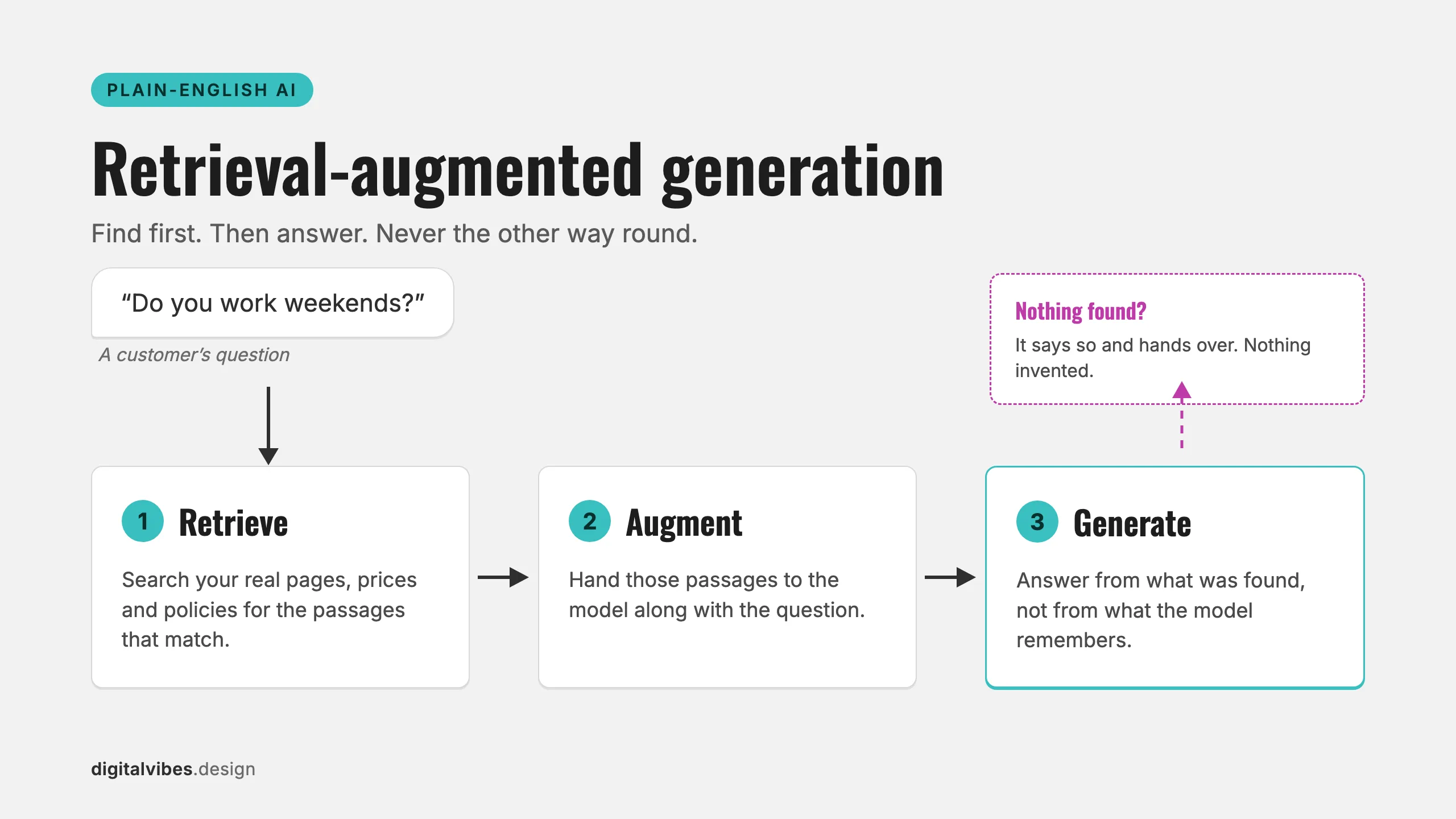
Retrieval-augmented generation, usually shortened to RAG, is the standard fix. This is what it does, in plain terms.
What RAG stands for
Retrieval-augmented generation. Three words doing exactly what they say.
Retrieval. The system goes and finds relevant information first.
Augmented. That information gets handed to the model along with the question.
Generation. The model writes an answer, using what it was given rather than what it remembers.
The order matters. Find, then answer. Not answer, then hope.
How it works, step by step
1. Your content gets split up. Every page, price list, policy, and FAQ is broken into passages small enough to be precise and large enough to still make sense on their own.
2. Each passage gets an address based on meaning. Not a keyword index. Each passage is converted into a vector, a list of numbers describing what it is about. This is why a passage about after-hours calls can be found by someone asking whether you work weekends, even though neither phrase appears in the other.
3. The question gets the same treatment. Someone asks something. The question becomes a vector too, and the system finds the passages closest to it in meaning.
4. The model answers from those passages only. The retrieved content goes to the model with the question and a clear instruction: answer from this, and if the answer is not here, say so.
5. Nothing found means nothing invented. When no relevant passage exists, a well-built system says it does not know and offers to hand over to a person. That behaviour is not a limitation. It is the whole reason to build it this way.
Why this matters if you run a business
Your prices stay your prices. A grounded assistant quotes what is written on your page. An ungrounded one quotes an average of what the internet thinks your industry charges.
Your service area stays your service area. It will not promise Hollister if you do not go to Hollister.
Wrong answers become fixable. When the assistant gets something wrong, the fix is editing the content it read. You are not guessing at prompt wording and hoping.
You can audit it. Every answer traces back to a passage somebody wrote. If you want to know why it said something, you can go and look.
What RAG does not fix
Worth being clear, because this gets oversold.
Grounding reduces error. It does not eliminate it. A model given the right passage can still summarise it badly, and a retrieval step can still fetch the wrong passage for an oddly worded question.
It also cannot retrieve what was never written down. If your prices, policies, and process only exist in your head, no amount of architecture helps. Writing them down is the first job, and it is usually the bigger one.
And some questions should reach a person regardless of how well the system performs. Anything where a wrong answer carries legal or financial weight belongs with a human, and any vendor who tells you otherwise is selling you a risk.
RAG versus pasting a document into ChatGPT
People ask this a lot and it is a fair question, because pasting a PDF into a chat window does work.
It works for one conversation. A retrieval system indexes everything you have, stays current as you update it, runs on your site for every visitor at once, and lets you check what it retrieved for any given answer. The difference is scale and persistence, not cleverness.
How much content do you need
Less than people expect. A normal small business site is enough: five to ten pages covering services, pricing, area, and process.
What matters is that it is accurate and current, not that there is a lot of it. Ten honest pages beat forty pages of marketing language, because marketing language does not contain answers.
Where the content lives
Worth asking any vendor. In the systems I build, the index sits in a Supabase database tied to the client’s own project, using pgvector. Not in a third-party vector service, and not used to train anyone’s model.
If a vendor cannot tell you where your content is stored and who else can read it, that is the answer.
The practical test
The practical test for any AI assistant on a business website is not how good it sounds when it knows something. It is what it does when it does not.
Ask it something specific that is not on the site. If it invents a confident answer, retrieval is either missing or badly built.
Further reading
- How this works in practice: the AI answering service
- Agents that act rather than answer: AI agent development
- Building it into something custom: custom AI development