
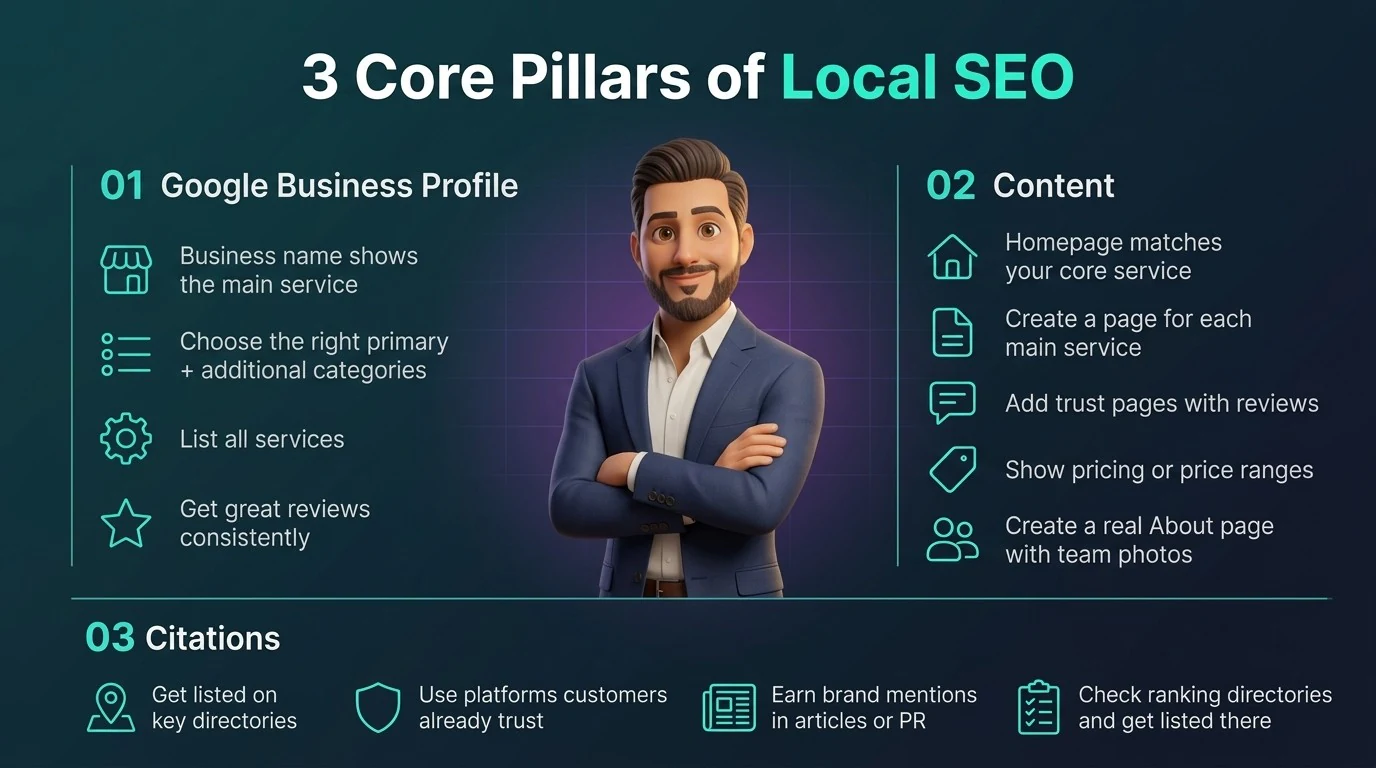

If I owned a local service business, here’s what I’d do to get more customers from Google. I’d focus on the big three local SEO topics:
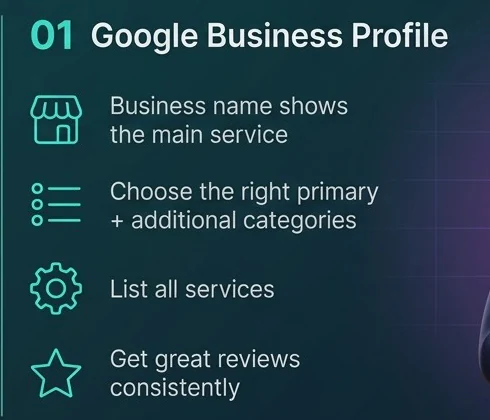
- Your profile, meaning your Google Business Profile
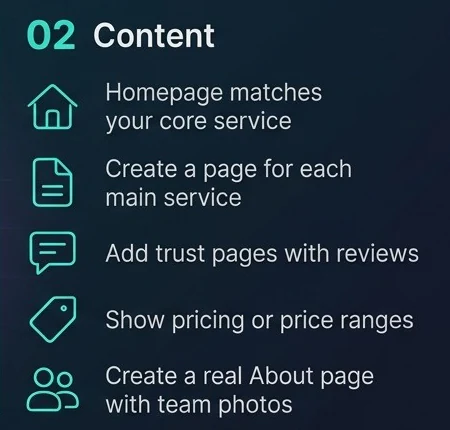
- Your content, meaning your website
- Your citations, meaning everywhere else your business is listed or mentioned
Here’s what each one means, and what I’d actually do.
1. Your Google Business Profile
This is the listing that shows up in the map pack. These are the big wins.
Name relevance
You want a name that tells a potential customer what you do the second they see it. That means having your main service in your business name. Our map pack lesson shows why: two of the top three auto shops in that Salinas search have “Auto Repair” right in their names.
If you can, change your business name for real. Get a DBA (“doing business as”) and update your signs, trucks, invoices and marketing, so the online world matches the offline world. Google’s rule is that your name should reflect your “real-world name, as used consistently on your storefront, website, stationery, and as known to customers.” Adding a keyword to your name only on Google is how profiles get suspended.
One thing to know before you do it: Google treats a name change that changes the services in your name as a new business. Its guidelines say you’d mark your current profile as closed and create a new one. So weigh the better name against starting over on a new profile, and check your situation with Google support before you commit.
Categories
Choose your primary and additional categories carefully. Google says to “select a primary category that best describes your business” and to use as few categories as possible to describe your core business. Your primary category should be your main service. Additional categories should be real services you offer, not a wish list.
Services
Fill out every service in the Services section of your profile. It’s free, it takes an afternoon, and it tells Google and your customers exactly what you do.
Reviews
I look at four things: the rating, what the reviews actually say, how many there are and how recent they are. In plain words, get a lot of great, detailed reviews on a regular basis. Google itself says more reviews and positive ratings can help your local ranking. Our guide to getting more Google reviews covers the link, the ask and the follow-up.
2. Your website content
For a local service business website, these are the big wins.
A homepage that matches your core service
Your homepage should be about your core business, the same one in your Google Business Profile name and primary category. You want to send Google one clear signal. And when someone clicks from your profile to your website, they should land on exactly what they were looking for, not bounce back to Google Maps and keep searching.
A page for each service
Create a dedicated page for each of your additional categories, or for each service you list on your Google Business Profile. This one’s very important. Someone searching for “water heater repair” should land on a water heater repair page, not your general homepage.
Trust pages
Build pages whose whole job is trust. A reviews page is the easiest one to start with: collect the reviews you’ve gotten everywhere, whether that’s Google, Facebook, Yelp, Trustpilot or a nice message on WhatsApp, and put them in one place.
A pricing page
I know a lot of business owners don’t want to show prices. But when people research a local service, price is one of the first things they look for. They look for comparisons, for their specific problem, for the best option and for proof, like reviews.
If your price depends on too many factors, at least give ranges, so customers know roughly what they’ll pay before they ask for a quote. If they have to wait for you to get back to them, and another website answers the question right away, they’ll go with the other business.
A real About page
Create an About page with your actual team: real faces, real names, no stock photos. People want to know who’s showing up at their home or business.
3. Citations
Citations are anywhere your business name, address and phone number show up online. There are two kinds:
- Structured citations are directory listings on sites like Yelp, Bing, Apple Maps and Yellow Pages.
- Unstructured citations are mentions of your business in articles, blog posts or press releases.
Citations still matter, especially structured ones on platforms like Apple Maps, Waze, Yelp and Trustpilot. They help confirm your business information, and they give you more places to collect reviews. In my experience, that improves your chances of ranking higher on Google and of getting mentioned in AI answers, like Google’s AI Overviews or ChatGPT. Our lesson on where AI gets its information shows which sources AI leans on most.
What I’d worry about less these days is perfect consistency. Google is good at working out which details belong to which business, so “Street” versus “St.” isn’t going to sink you. Put that energy into reviews on the platforms that matter, and into getting listed where your customers already are, so you pick up the free traffic those sites already get.
How to find the directories that matter
Search your main service in your city and look through the first three pages of Google. Then check the AI Overviews for different searches your customers might use, and see which pages show up. If it’s competitors, study their content. If it’s directories, get your business listed there too.
Here’s what that looks like in practice. When we searched “auto repair salinas ca” on September 23, 2026, the first three pages included Yelp (twice), Facebook, a Reddit thread in r/Salinas, AAA’s list of Approved Auto Repair shops, Craigslist, Carfax and MapQuest. For a Salinas auto shop, AAA and Carfax are exactly the kind of industry directories worth being on, and a generic “top 50 directories” list would never tell you that.
Summary
If I ran a local service business, I’d put my time into three things:
- A Google Business Profile with a name that says what I do, the right categories, every service filled in and a steady flow of good reviews.
- A website with a homepage that matches my main service, a page for each service, a reviews page, a pricing page and a real About page.
- Citations on the platforms where my customers already look, found by checking what actually shows up on Google.
Once the website is live, make sure Google actually has it with Search Console, and see what visitors do on it with Google Analytics.
Want to see where your business stands on the map right now? A free local rank audit runs your search from points across your service area.