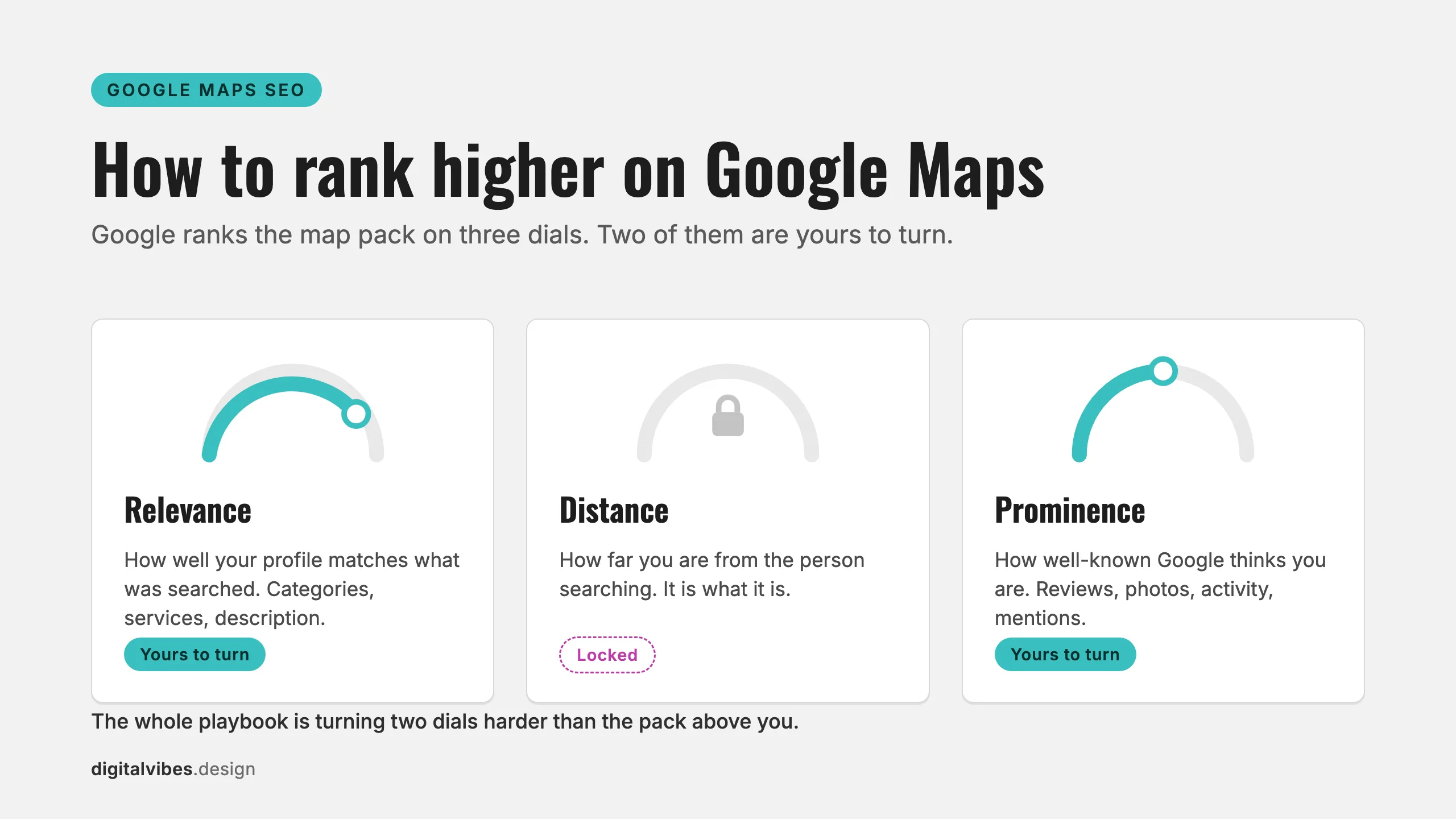
Google ranks the map pack on three factors: relevance, distance, and prominence. You cannot move your building, so ranking higher on Google Maps means turning the other two dials harder than the businesses above you: make your profile match more searches (relevance), and give Google more evidence that you are the known choice (prominence). In practice that is six jobs: the right categories, a complete profile, a steady review engine, replies to every review, fresh photos and posts, and links from real local websites.
None of it can be bought. Google’s words: “There’s no way to request or pay for a better local ranking on Google” (Google). Everything below is what the labor actually looks like, with each claim quoted from Google’s documentation, Google’s own 2026 Business Profile playbook, Whitespark’s expert survey, or BrightLocal’s consumer research.
Key takeaways
- In Whitespark’s 2026 survey of 47 local search experts scoring 187 factors, the number one local pack factor is your “Primary GBP Category.”
- Reviews are now a threshold, not a bonus: 68% of consumers require at least 4 stars and 47% will not use a business with fewer than 20 reviews (BrightLocal, 2026).
- Responding matters almost as much as getting reviews: 89% of consumers expect owners to respond, and 80% are more likely to use a business that answers every review.
- Google’s 2026 playbook, citing internal data: businesses with photos get “42% more requests for directions,” and complete profiles get “7x more clicks.”
First: showing up on Google Maps at all
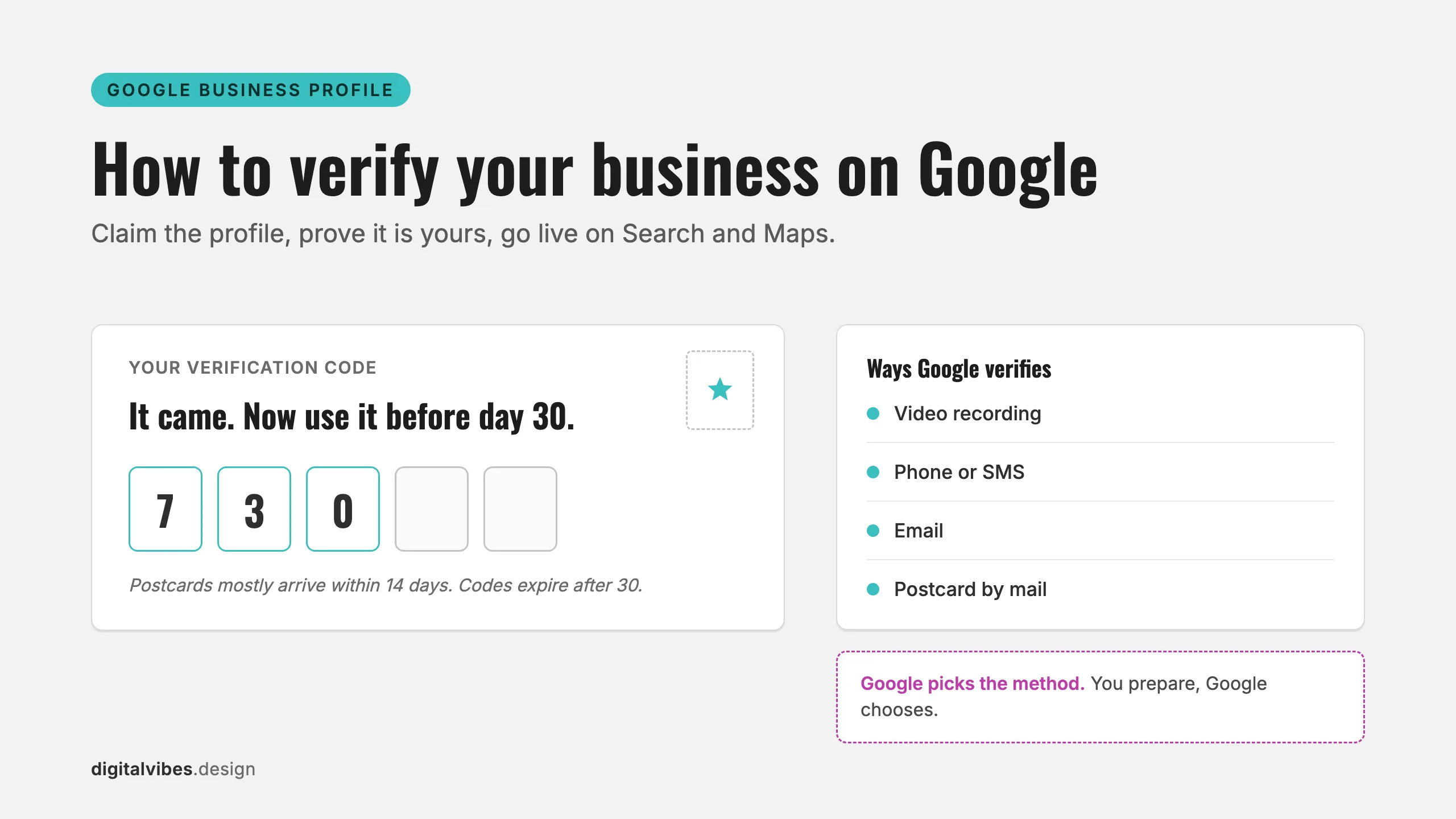
Ranking higher assumes you are on the board. If your business does not appear even when you search its exact name, that is not a ranking problem: work through how to verify your business on Google to get listed, or the five reasons a business is invisible if a profile exists but never shows. Come back here once you are live and merely losing.
The three dials, and the two you can turn
Google defines the contest in three sentences (Google): relevance is “how well a Business Profile matches what someone is searching for,” distance is “how far each business is from the customer who’s searching,” and prominence is “how well-known a business is,” which the same page says is “based on info like how many websites link to your business and how many reviews you have.”
Distance is locked. Every tactic that works is a relevance tactic or a prominence tactic. Every tactic that gets profiles suspended is an attempt to fake one of the two. That is the whole map; here are the six dial-turns in order of leverage.
1. Get the primary category exactly right
Whitespark’s 2026 Local Search Ranking Factors report, an expert survey where “47 of the best and the brightest local search experts” score 187 factors, ranks “Primary GBP Category” as the single most impactful local pack factor (Whitespark). We break the full survey down for local businesses in local search ranking factors 2026. Ahead of everything you will spend money on.
Pick the most specific primary category that describes what you actually are (“Emergency plumber” beats “Plumber” if that is the work you want), then use the secondary slots: Google’s 2026 playbook confirms “You may add up to 10 categories in total: one primary and nine secondary” (Google GBP Playbook 2026, PDF). Check what primary category the three businesses above you use; if yours differs, you may be competing in the wrong contest entirely.
2. Fill in every field, then keep it current
Google says it flatly: “Businesses with complete and accurate info are more likely to show up in local search results,” and asks specifically for your full address, hours “including special store hours,” what kind of business you are, and “other details such as parking or Wi-Fi availability” (Google). Hours matter more than they look: “Business is Open at Time of Search” is a top-five factor in Whitespark’s 2026 ranking, which means wrong hours can drop you out of the pack exactly when people are searching.
The payoff Google claims for this boring work, from its 2026 playbook citing internal data: complete profiles receive “7x more clicks,” and regularly updated profiles get “5x more views.”
3. Build a review engine, not a review pile
Google’s prominence definition ends with the sentence that funds this whole tactic: “More reviews and positive ratings can help your business’s local ranking.” Whitespark’s 2026 report adds that four of the top 20 factors involve reviews, including “having a high numerical rating” and “having a sustained influx of reviews… consistently over time.”
Consumers have quietly raised the bar too. From BrightLocal’s 2026 survey of 1,002 US consumers (BrightLocal):
Recency is the underrated half: 74% of consumers look for reviews from the last three months, and 32% look for the last two weeks, up from 20% a year earlier. Fifty reviews from 2023 lose to fifteen reviews from this quarter. The system that wins is an ask sent to every customer within a day of the job, every time.
Two things the engine must never do, straight from Google’s Maps content policy: no incentives (“payment, discounts, free goods and/or services” for reviews), and no gating: you may not “discourage or prohibit negative reviews, or selectively solicit positive reviews from customers.” Ask everyone, reward no one. The mechanics of the ask, from the review link to the wording that converts, are in how to get more Google reviews.
4. Reply to every single review
Google’s advice page puts review responses on its official ranking-tips list: “When you reply to customer reviews, it shows that you value their feedback” (Google). Whatever weight it carries in the algorithm, it carries enormous weight with the humans deciding whether to call you: 89% of consumers expect responses, 42% are unlikely to use businesses that ignore reviews, and 81% expect a reply within a week (BrightLocal, 2026).
One warning from the same survey: 50% view generic, templated responses negatively. Three specific sentences beat a paragraph of copy-paste gratitude. For the reply formula and worked examples at every star rating, see how to respond to Google reviews.
5. Feed it photos and weekly activity
Google’s 2026 playbook, citing internal data, attaches numbers to photos that no other free tactic gets: businesses with photos on their profiles “receive 42% more requests for directions on Google Maps” and “35% more clicks through to their websites,” and “90% of people are more likely to visit you if you have photos of your business” (Google GBP Playbook 2026). The same playbook’s posting advice is one line: “Post at least once a week.”
Real job photos beat stock every time: the truck, the finished work, the before-and-after. They feed relevance (Google sees what you do) and prominence (an active profile reads as a real, known business).
6. Earn links and mentions from your actual community
The last lever is the one Google names inside its prominence definition: “how many websites link to your business.” For a local business this is not a link-buying scheme; it is the chamber of commerce page, the supplier directory, the youth team you sponsor, the local news story about the shop. Whitespark’s survey tracks these as its Link and Citation signal groups, and consistent listings across real directories remain part of the expert playbook even though Google publishes no rule about them.
What does not work (and what gets you removed)
- Paying for position. Once more: “There’s no way to request or pay for a better local ranking on Google.” Ads buy labeled ad slots, not pack positions.
- Stuffing keywords into your business name. Awkwardly, Whitespark’s experts rank “Keywords in GBP Business Title” among the top five factors, and it is also a direct violation of Google’s rule that your name “reflect your business’s real-world name.” It works right up until a competitor reports you or a suspension lands, and a suspended profile shows to no one. Skip it.
- Fake or farmed reviews. Google’s policy requires contributions to “reflect a genuine experience at a place or business,” and US regulators have moved against fake-review schemes too. The risk is existential, the benefit temporary.
Frequently asked questions
How long does it take to rank higher on Google Maps?
Google publishes one hard number: “Rankings for new businesses can take up to a month to appear in search results.” Beyond that, expect movement over weeks and months, not days: reviews accumulate, photos add up, and Whitespark’s experts specifically reward a “sustained influx” over bursts.
Why does a competitor with fewer reviews outrank me?
Because reviews are one input to one of three factors. A competitor with a sharper primary category (relevance), a closer address to the searcher (distance), or better hours coverage can sit above you with half your stars. Audit their categories and completeness before assuming the algorithm is broken.
Do Google Ads improve Maps ranking?
No. Ads buy the sponsored slots that appear above and inside the map, clearly labeled. The organic pack order stays governed by relevance, distance, and prominence, and Google states there is no way to pay for it.
How many reviews do I need?
There is no magic number, but there is a consumer threshold: 47% of consumers will not use a business with fewer than 20 reviews, and 68% require at least 4 stars (BrightLocal, 2026). Clear 20 with a 4+ average, then compete on recency and responses.
The bottom line
You rank higher on Google Maps by turning the relevance dial (exact primary category, every field complete, accurate hours) and the prominence dial (reviews arriving weekly and answered, photos and posts every week, links from real local sites), because the distance dial does not turn. It is not complicated. It is just weekly, forever, which is exactly why the businesses that systematize it own the pack.
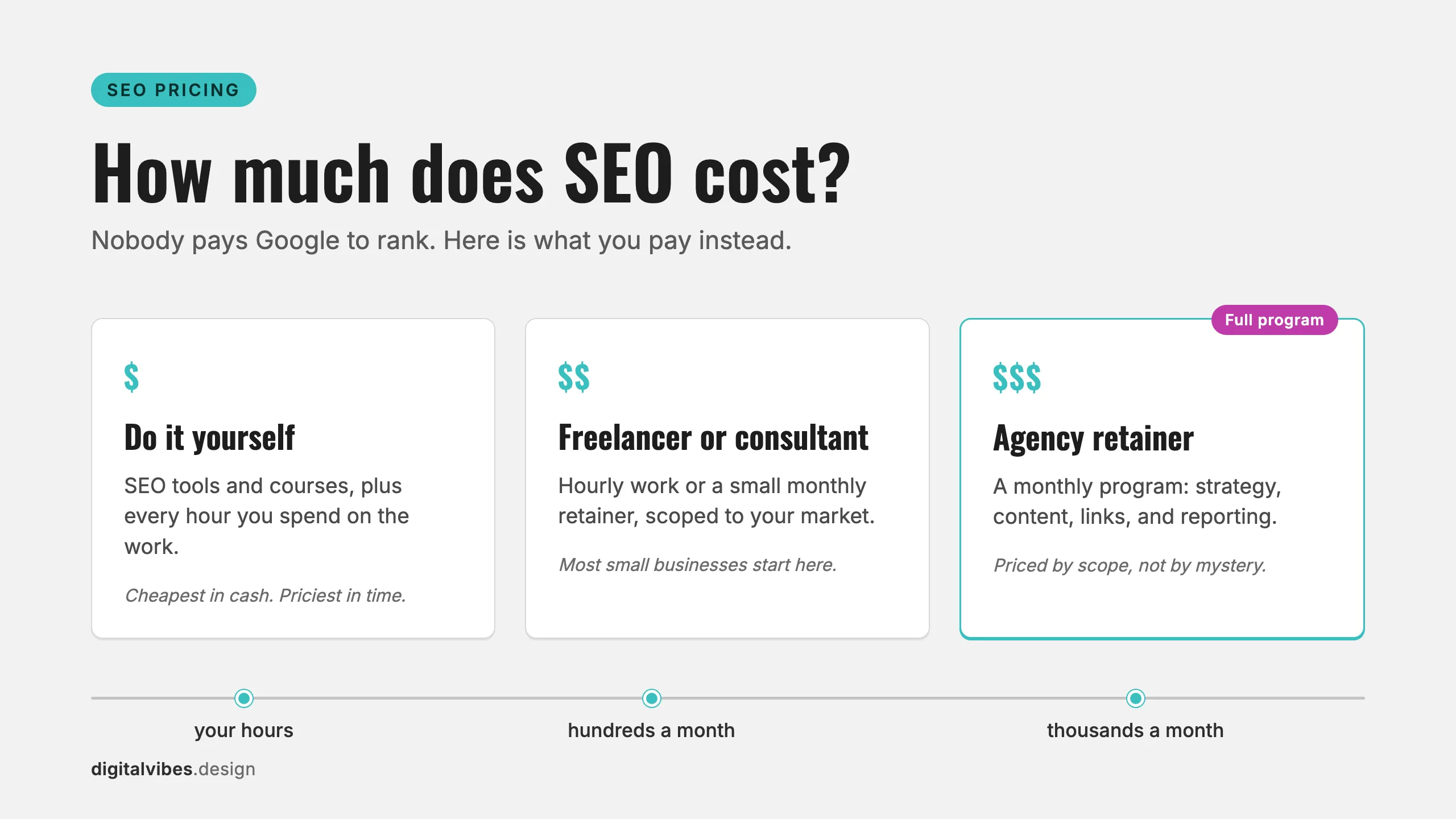
See which dial is costing you first: our free 60-second GBP scan grades your profile against what is ranking around you, no signup. If you want the whole playbook run for you, the $650 one-time optimization fixes the relevance side, and the $550 a month plan keeps the prominence side fed with keyword-driven content, posting, photos, and review management.