

You searched once. Google ran five contests.
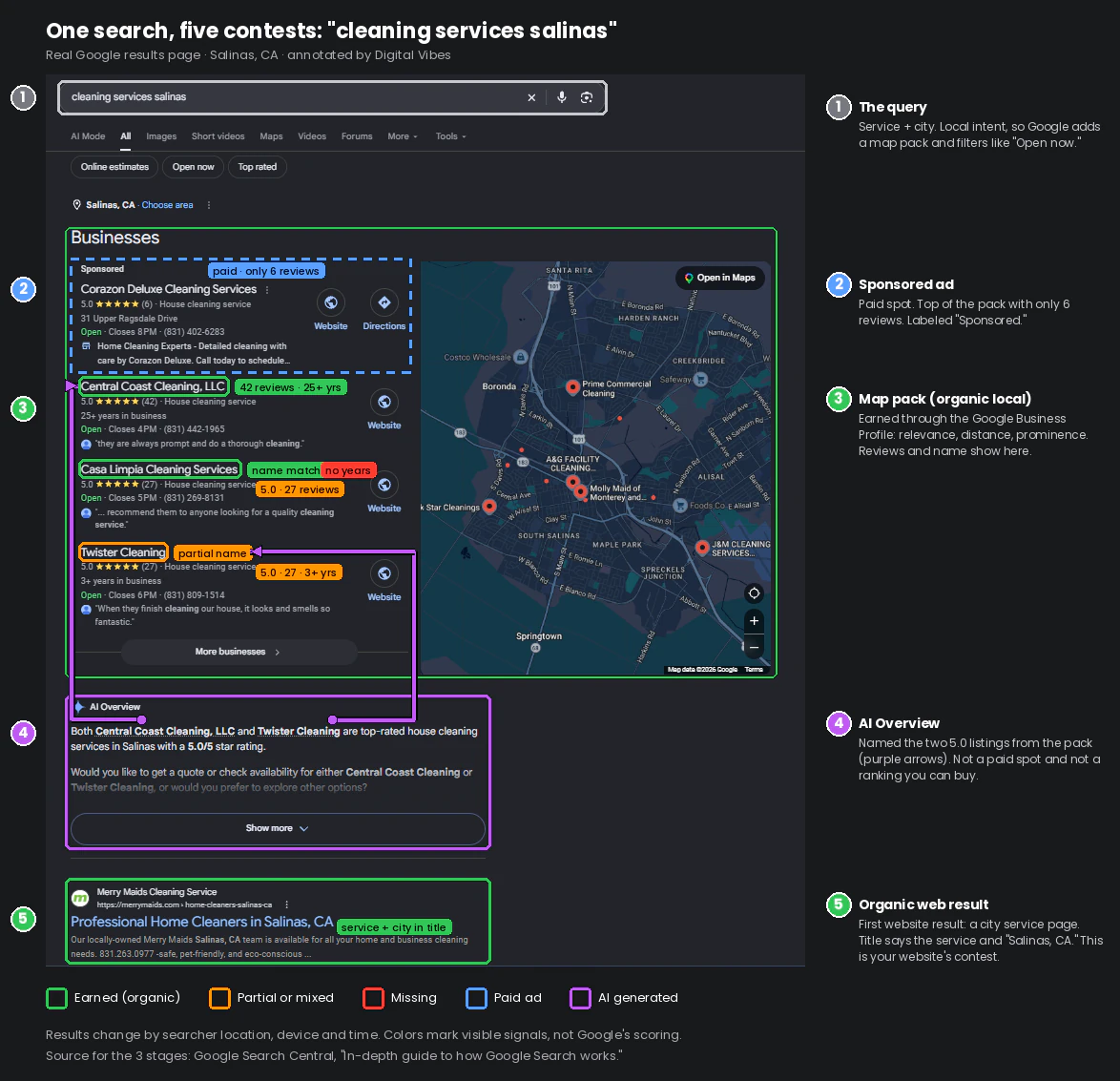
Here’s a real results page for “cleaning services salinas.” It looks like one list, but it’s really five different zones, and each one is won a different way. Some you earn, one you pay for, and one is written by AI. Only one of them is decided by your website.
Knowing which is which is the whole game. Let’s start with how Google gets to a results page at all.
How Google finds, stores and picks pages
Google describes Search as three stages, and not every page makes it through all three (Google Search Central).
Crawling: Google has to find your pages first. Its crawler discovers them through links from other pages and through a sitemap you submit. No links pointing to your site and no sitemap means it may never visit. Our web crawler lesson shows how a crawler moves through a site, link by link. What to check: your sitemap is submitted, nothing is blocking Google, and your site loads without errors. Google Search Console shows all three stages for your own site; our Search Console lesson walks through a real one.
Indexing: Google reads what it found and files it. It looks at your text, your page titles, your images, and picks one version when pages look like duplicates. Thin or copied pages may not get filed. What to check: each service has its own real page, and each title says the service and the city.
Serving: When someone searches, Google picks results from what it filed. Google says relevance comes from hundreds of factors, including the searcher’s location, language and device. That’s why a local search like this one brings up a map pack. What to check: your pages match the exact services and areas you want to win.
Two things Google says outright: it doesn’t take payment to crawl a site more often or rank it higher, and it doesn’t guarantee any page will be crawled, filed or shown. Ads are a separate, labeled product.
How to read the colors
- Green is earned. The business won it without paying.
- Orange is partial or mixed.
- Red is missing.
- Blue is a paid ad.
- Purple is AI-generated.
The colors mark what you can see on the page, not how Google scores it.
The five zones, one by one
Zone 1: the search
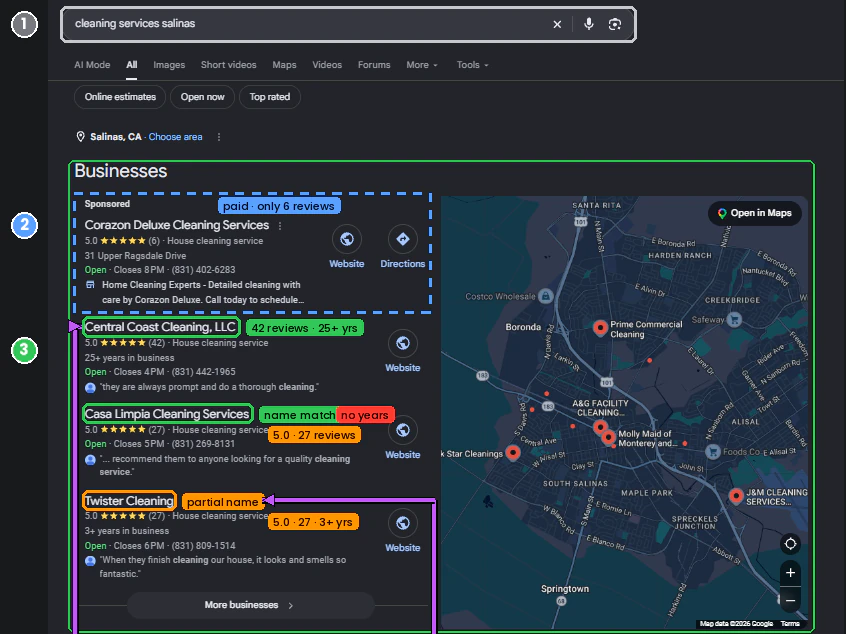
What showed: “cleaning services salinas,” plus filter chips for “Online estimates,” “Open now” and “Top rated.”
What it means: There’s nothing to win here, but it sets everything else. A service plus a city tells Google the searcher wants someone local, so Google adds a map pack. The chips are a nice hint, too: people choosing a cleaner care about quotes, hours and ratings.
Zone 2: the sponsored ad
What showed: Corazon Deluxe Cleaning Services, at the very top of the map pack, with a 5.0 rating on 6 reviews.
What earns the spot: Money. It’s labeled “Sponsored.” It sits above businesses with far more reviews because it paid to be there, not because it ranked there. Before you compare yourself to the business at the top, check for that label.
Zone 3: the map pack
What showed: three businesses.
- Central Coast Cleaning, LLC: 5.0 on 42 reviews, 25+ years in business.
- Casa Limpia Cleaning Services: 5.0 on 27 reviews, with “Cleaning Services” right in the name, but no years in business shown.
- Twister Cleaning: 5.0 on 27 reviews, 3+ years, with a name that matches the search only partly.
What earns the spot: your Google Business Profile. Google says local results come down to relevance, distance and prominence, and that prominence includes how many reviews you have and how many websites link to you. Reviews, categories and your name are the signals you can see. Our map pack lesson walks through this zone in detail.
One more thing to notice: the labeled pins on the map (Prime Commercial Cleaning, A&G Facility Cleaning, Molly Maid, J&M Cleaning Services) aren’t the three businesses in the list. The map shows more businesses than the list does, so don’t read the pins as the ranking.
Zone 4: the AI Overview
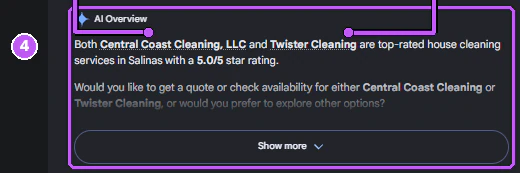
What showed: an AI answer that named Central Coast Cleaning and Twister Cleaning as top-rated house cleaning services with a 5.0 rating.
What earns the spot: nobody knows exactly. Here it seems to have pulled from the map pack’s listings and reviews. It isn’t paid, and it isn’t a ranking you can buy.
It also skipped Casa Limpia, which has the same 5.0 and the same 27 reviews as Twister. We can’t tell you why. AI answers change from one search to the next, so treat this as what happened once, not as a rule.
Google says there are no extra requirements to show up in AI Overviews: no special schema, and no new AI text files like llms.txt. A page just has to be indexed and eligible to show in Search with a snippet, and Google also lists keeping your Business Profile information up to date. It also says AI Overviews often don’t show at all. So be wary of anyone selling “we’ll get you into the AI Overview.” For which sources AI actually pulls from, see where AI gets its information.
Zone 5: the first website result
What showed: Merry Maids’ Salinas page, titled “Professional Home Cleaners in Salinas, CA.”
What earns the spot: the website itself. It’s a page built for one service in one city, with both in the title, and Google has crawled it, filed it and matched it to the search. This is the one zone your website competes in.
What the numbers say
Here’s the search demand behind this page, from our SEO tools (US data, September 2026):
| Search | Searches a month | Difficulty (0-100) | Cost per ad click | Ad competition (0-1) |
|---|---|---|---|---|
| cleaning services salinas | 70 | 0 | $4.87 | 0.87 |
| house cleaning salinas | 70 | 0 | $5.51 | 0.66 |
| cleaning services near me (all US) | 110,000 | 25 | $10.82 | 0.64 |
| house cleaning near me (all US) | 60,500 | 15 | $10.07 | 0.62 |
The gap is the point. “Cleaning services salinas” is close to zero difficulty to rank for, but advertisers pay almost $5 a click and the ad competition is high. It’s easy to win organically and crowded in ads.
Two notes on reading this. “Cleaning services salinas” and “cleaning services salinas ca” show the same numbers, which usually means Google groups close variations together, so treat them as one pool of searches, not double. And the “near me” rows cover the whole country. Plenty of people in Salinas search “near me” and still get the local map pack, but this data can’t tell us how many.
What this screenshot can’t tell you
One screenshot is one search, from one place, on one device, at one moment. Google says the searcher’s location, language and device all shape the results.
We checked. When we ran the same search in Google Maps from downtown Salinas the same day, the top three were Molly Maid, A&G Facility Cleaning Services and Spiffy Cleaning Services, and none of the three businesses in this screenshot made the top 10. Same city, same day, different results.
We also saw one business win two contests at once. In a separate check of the regular website results, Central Coast Cleaning’s own website came in third among the website results, so it’s in both the map pack and the organic results. That’s what a strong profile plus a real website can do.
Which zone to go after first
For most local service businesses, I’d go after the map pack first. It’s at the top, it doesn’t cost you per click, and it’s won with things you control: your Google Business Profile and your reviews.
Next, your website, zone 5. Give each service its own page, and put the service and your city in the title, the way Merry Maids did.
Ads (zone 2) are optional. They buy a spot right away, but you pay for every click, and on this search advertisers are already paying almost $5 each.
And the AI Overview (zone 4) isn’t a separate project. Google says there’s no special trick for it, so if you win the map pack and build a good website, you’re doing what you can.
Summary
One Google search is really five contests: the search itself, a paid ad, the map pack, an AI answer and the website results. You can compete in three of them without paying a cent. Start with the map pack, then build a website with a real page for each service, and skip anyone who promises to buy you into the AI Overview.
If you want help with the first contest, see how we manage Google Business Profiles. For the fifth, see how we build websites for local businesses. Or start by seeing where you rank today with a free local rank audit.