If you run Facebook ads to get people to fill out a form and then book a call, you have probably felt stuck between two bad choices. Optimize for the form and you get cheap leads that never book. Optimize for the booked call and Meta does not see enough of them to learn, so every lead gets expensive.
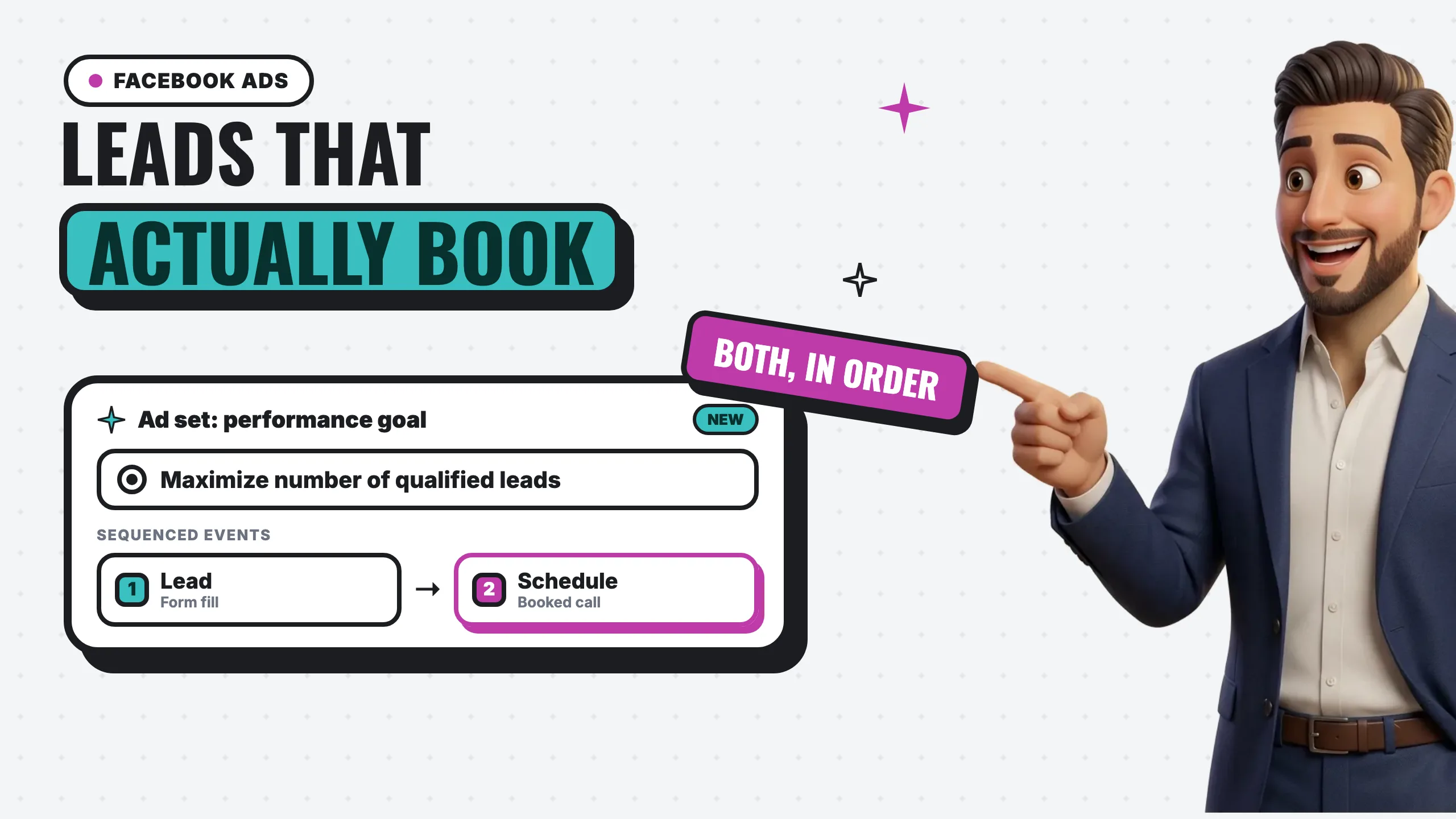
Meta now has a third option. In a Leads campaign that sends people to your website, there is a performance goal called “Maximize number of qualified leads,” and with it a setting called Sequenced Events: you pick two events, like a form fill and then a booked appointment, and Meta optimizes for people who do both, in that order.
It is new enough that Meta has not published help documentation for the website version yet, so this post sticks to what the setting shows on screen and what has been documented by people testing it. We will update it as Meta adds official guidance.
Key takeaways
- It lives in the ad set of a Leads campaign with the conversion location set to Website.
- The new performance goal is “Maximize number of qualified leads.” Meta says it will “try to show your ads to the people most likely to convert after sharing their contact information with you.”
- You build a sequence of two events. In Meta’s words: “Your ad is credited only if both events occur in order.”
- It fits two-step funnels: a quote request, lead magnet or webinar sign-up first, a booked call or appointment second. If your ad goes straight to a booking page, it changes little.
- It needs volume. Events appear to need the Conversions API, and the final event needs enough activity for Meta to learn from it.
- Judge it on cost per booked call, not cost per lead.
- A setting is not a strategy. Keep researching your own industry and competitors; what works for someone else may not work in your niche.
The problem it solves
Most service businesses do not sell on the first click. Someone sees the ad, fills out a short form, and only later books the call, the estimate or the appointment that turns into money. That leaves two places to point Meta’s optimization:
- At the form. Meta finds lots of people who fill out forms. Many of them never pick up the phone. Cheap leads, weak pipeline.
- At the booking. Meta finds people more like your actual customers, but if only a handful book each week, it is learning from a trickle. Costs climb and the ad set can sit in limited learning.
Sequenced Events sits between the two. You still tell Meta that the booking is what matters, but you also give it the earlier step to work with.
Meta has offered a version of this before, but only for Instant Forms (the forms that open inside Facebook and Instagram), where it relied on sending CRM events back to Meta. Meta’s help center calls these conversion events for lead ads, and the goal used to be called “conversion leads.” The new part is that it now works for leads on your own website.
How to set it up
- In Ads Manager, create a campaign with the Leads objective.
- In the ad set, set the conversion location to Website.
- Under performance goal, choose Maximize number of qualified leads instead of the default “Maximize number of leads.”
- Select your dataset. That is your Meta pixel.
- Under the lead event, choose Sequenced Events, then create a sequence.
- Pick the first event: the first step someone takes, such as Lead, Complete Registration or a submitted application.
- Pick the final event: the step that actually matters, such as Schedule (a booked call or appointment) or a qualified-lead event from your CRM.
- Save the sequence, finish the ad set as usual, and launch.
Meta’s own description of the sequence screen is the most useful line in the whole setup: “Specify two events to optimize for a higher-value action that occurs after an initial event. Your ad is credited only if both events occur in order.” Someone who books without filling out the form first, or who only fills out the form, does not count.
What to know before you switch
Your events need to be clean, and probably server-side. If you are not sure what your site is tracking today, start with how to read Google Analytics and check that a form fill and a booking each show up as their own event. In the most detailed walkthrough published so far, every event that could be picked as the first step was coming in through the Conversions API, not just the browser pixel. If your site only fires the pixel, fix tracking first.
Volume decides whether it works. Not every event can be used. Meta labels some as “high event activity,” and the same walkthrough found eligibility seemed to cut off at around 30 optimized events in the past seven days. The usual rule of thumb for getting an ad set out of the learning phase is 25 to 50 optimized events a week, and here that means 25 to 50 people who did both steps, not just the first.
The attribution setting is locked. Only the standard attribution model is available with this goal. Advertisers testing it report that 7-day click is the only window offered, and that the final event gets its own window counted from when the first event happens. If your customers usually take more than a week to go from form to booking, Meta will miss some of them, and you should expect that.
Results report on the final event. Advertisers testing it report that cost per result and the learning phase follow the final event in the sequence, so the ad set can still show limited learning while it gathers bookings. Look at the earlier step’s cost too, but make the decision on cost per booked call.
It is still rolling out. Meta first tested Sequenced Events with Instant Forms in August 2026, and the website version is only now showing up in accounts. If you do not see it yet, it has not reached your account.
Who should test it
Good fit:
- A contractor, med spa, law office or agency running ads to a quote or consultation form, with booking as the next step.
- Lead magnet, webinar or free-trial funnels where a call or appointment follows.
- Accounts already getting a steady number of bookings each week from Meta, so the final event has enough volume.
Not much change:
- Ads that send people straight to a booking page or phone call. There is only one step, so there is nothing to sequence.
- Accounts with only a few bookings a month. Meta will not have enough to learn from yet. Start with a clean single-event setup and better tracking.
How we would run the test
- Make sure both events fire on the website and through the Conversions API, and check them in Events Manager before spending a dollar.
- Duplicate your current best ad set and change only the performance goal and the sequence. Same audience, same ads, same budget, so the comparison is fair.
- Give it at least two weeks before judging. A new ad set always looks strange in its first days.
- Compare cost per booked call and show-up rate, not cost per lead. A form fill that never books is not a cheaper lead.
- Keep the winner, then test creative on it. More signal from the first step should also make it easier to see which ads actually work.
If people book through your site, make booking as easy as possible on the page they land on: one clear action, the number where the thumb is, and the question answered before they have to ask (here is what that looks like). Our AI booking agent answers questions and books appointments around the clock, which shortens the gap between the form and the call. That is exactly the gap this setting is measured on.
A setting is not a strategy
A new setting like this one is a tool, not an answer. The results other advertisers share come from their audience, their offer and their market, and none of those are yours.
That’s why I always keep my competitor and industry research hat on whenever I run ads, whether on Meta or Google. No tool or setting can provide the insights I gain from deeply researching my own industry and competitors. Since what works for someone else might not work in your specific niche, I always tightly monitor my own field, even while drawing inspiration from other industries.
No setting replaces knowing your own market. Test what is new, but read the results against your own industry and competitors, not someone else’s.
In practice, that means looking at which offers and ads competitors in your field keep running, what your customers actually ask before they book, and how your numbers move compared with your own past results. Use Meta’s new setting to get better signals. Use your research to decide what those signals mean.
The short version
Meta’s new Maximize number of qualified leads goal, with Sequenced Events, lets website lead campaigns optimize for people who fill out the form and book. For two-step funnels with steady volume, it is worth a test this month. Set up clean events first, compare against your current ad set, and judge it on booked calls.
Want help setting it up? We build and manage Meta and Google campaigns for local businesses, with tracking done right from day one. Everything is priced on our pricing page, and if you are weighing other channels, here is our take on ChatGPT Ads for local business.