
Your next customer might see your work on TikTok, ask about you in a neighborhood Facebook group, get a second opinion from ChatGPT, then Google your reviews and call you. When they do, your website analytics will show one thing: a visit and a phone call. Everything that actually convinced them happened somewhere else.
That’s the idea behind “search everywhere optimization.” People still search on Google, a lot. But the decision about which business to call now gets made across a handful of apps, and most of them don’t report back to you.
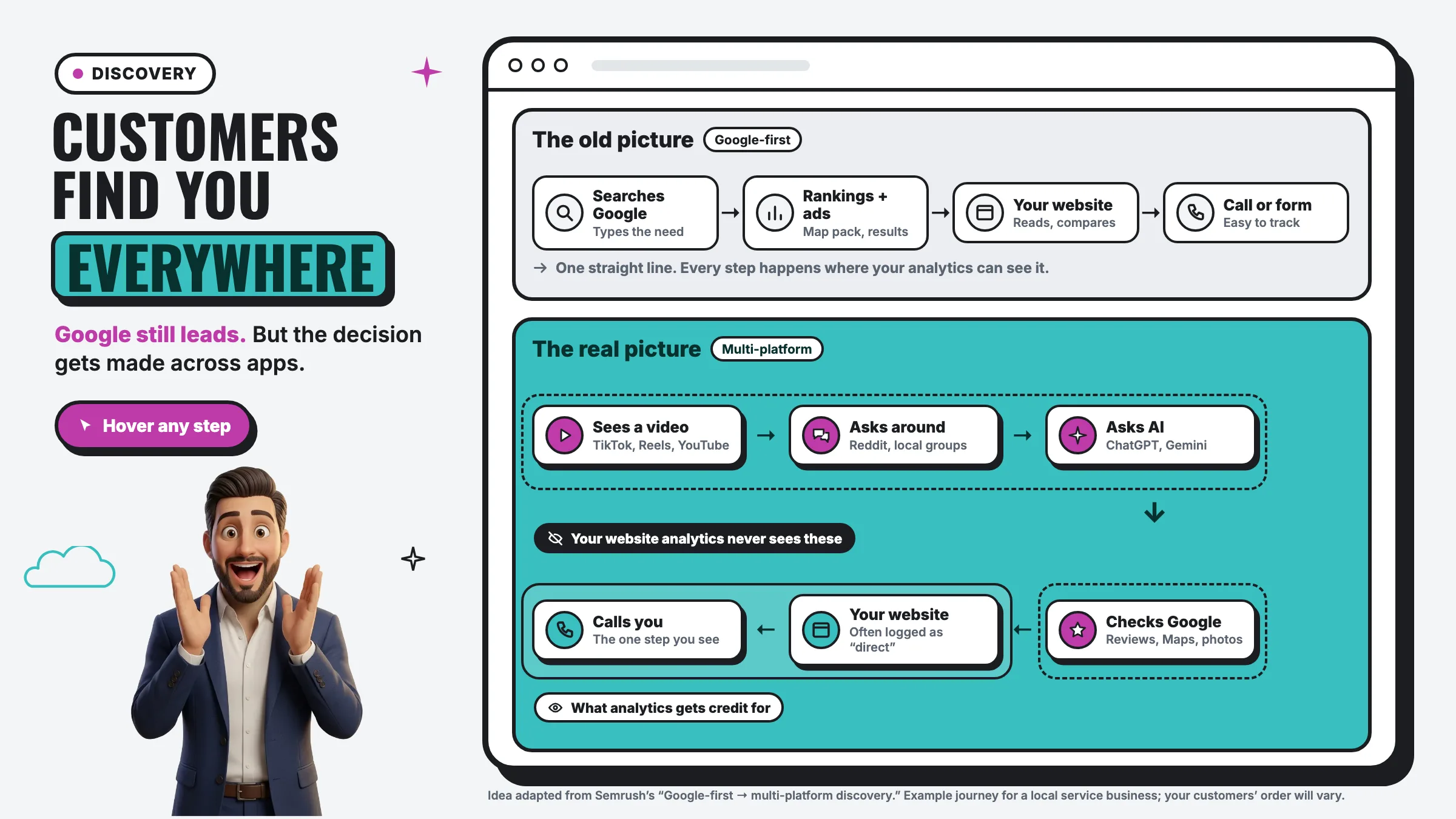
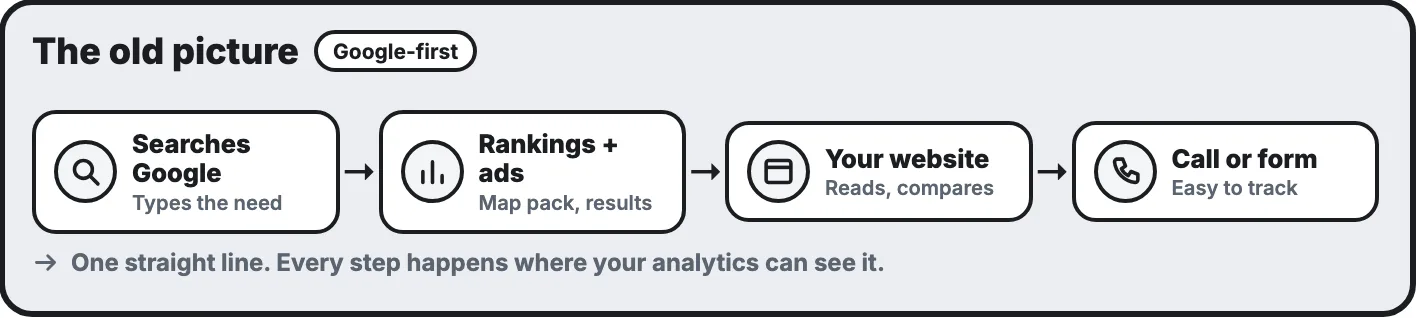
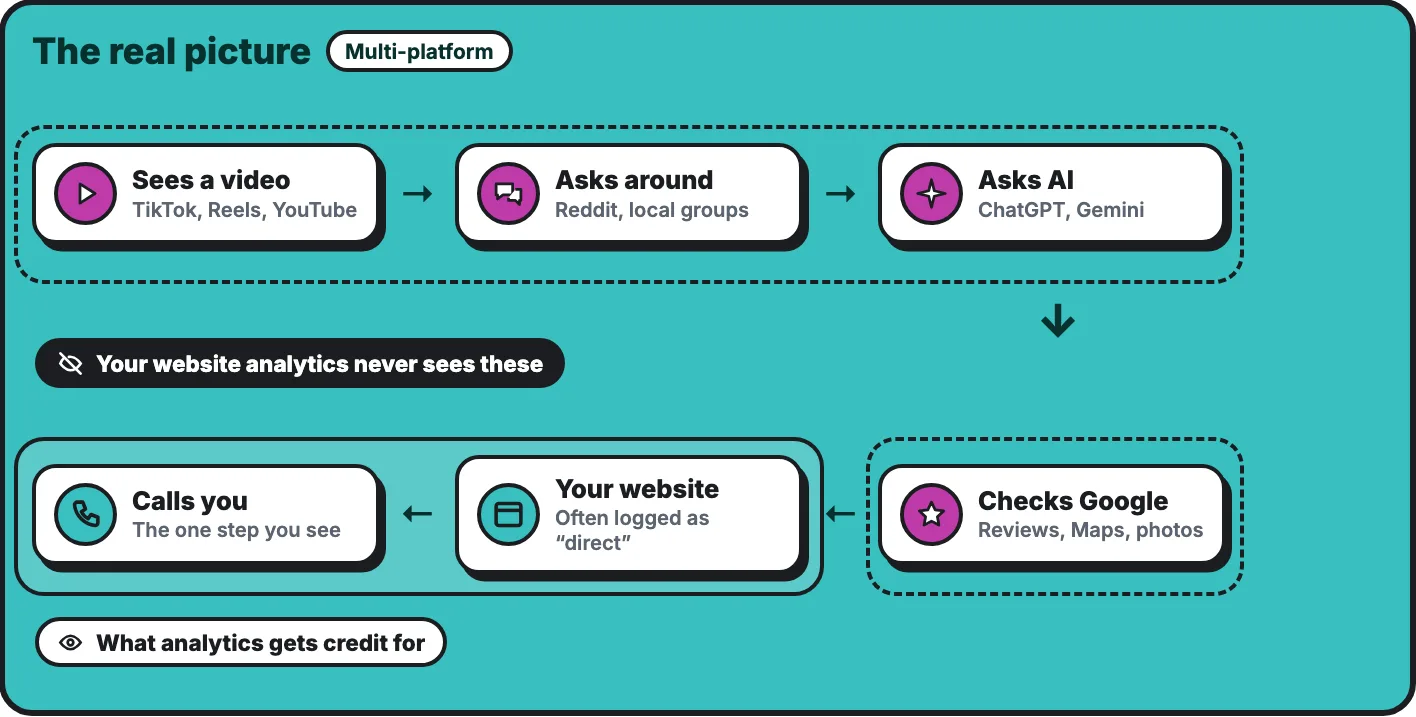
The illustration above is my take on an infographic Semrush shared, called “Google-first → multi-platform discovery.” I redrew it as a local service business example, and marked which steps your analytics can see and which ones it can’t.
Google still leads (and that’s not the point)
Let’s start with the number that gets passed around: “Google holds 73% of discovery across 41 major surfaces.” The real figure comes from SparkToro’s 2026 research with Datos, and it’s a little different: Google had 73.7% of all desktop searches across 41 major sites in the US in the last quarter of 2025. AI tools like ChatGPT were 3.2%.
Two things are worth knowing about that number:
- It’s desktop only. SparkToro says plainly that “a huge percent of search takes place in mobile browsers and apps, which were not included.” That means TikTok, Instagram and most phone searching aren’t in it.
- It’s searches, not decisions. Someone can search Google once and still make up their mind somewhere else.
So Google is still the biggest door, and I’d never tell a local business to ignore it. The point is that it’s no longer the only room people walk through.
The old picture: one straight line
The top half of the illustration is how most of us were taught marketing works:
- Someone searches Google.
- They see your map listing, your ranking or your ad.
- They read your website.
- They call or fill out a form.
Why it was nice: every step happened where you could measure it. Google Analytics could tell you exactly where the call came from.
The real picture: a loop across apps
The bottom half is what it looks like now for a lot of customers:
- Sees a video: a 30-second clip of your work on TikTok, Reels or YouTube.
- Asks around: “Anyone used these guys?” in a local Facebook group, Nextdoor or a city subreddit.
- Asks AI: “Who’s a good roofer in Salinas?” in ChatGPT or Gemini.
- Checks Google: reviews, photos and hours on your Business Profile.
- Visits your website: usually by typing your name, not by clicking a link.
- Calls you.
The order changes from person to person. What doesn’t change is that most of it happens off your website.
AI is now one of the stops
The 43% number is real too, with a detail that matters. In a Semrush survey of 1,030 US shoppers who have tried AI tools (December 2025), 43% said they’ve discovered a new brand through AI. That’s 43% of AI users, not of all consumers.
For local businesses specifically, BrightLocal’s 2026 survey found 45% of US consumers have used AI tools for local business recommendations.
And people don’t just take the AI’s word for it. In the same Semrush survey:
- 86% check AI recommendations at least sometimes.
- Google is the #1 place they check (68%), then the brand’s own website (48%), review sites and YouTube (35% each), friends or family (33%) and social media (30%).
- 77% use AI and search engines together. Only 4% rely mostly on AI.
That’s the loop in the illustration. AI might put you on the list, and Google, your reviews and your website decide whether you stay on it. Our lesson on where AI gets its information shows which sources AI pulls from for local businesses.
Why your analytics has no idea
Here’s the part that surprises business owners the most. Your website reports can only see visits to your website. So:
- The video they watched doesn’t show up.
- The Facebook group thread doesn’t show up.
- The ChatGPT conversation doesn’t show up, unless they clicked a link in it.
- The reviews they read on Maps don’t show up in your website reports either.
When they finally type your web address, Google Analytics files the visit under Direct, which Google defines as arriving “via a saved link or by entering your URL.” So the video and the AI answer that did the convincing get zero credit, and “Direct” looks like it’s doing all the work.
One improvement: Google Analytics now has an AI Assistant channel for visits that click through from ChatGPT, Gemini, Copilot and similar tools. It only counts people who click, though, and it doesn’t include Google’s own AI Overviews or AI Mode. Our Google Analytics lesson shows where to find your channels.
What I’d do about it
You can’t track every step, so stop trying to. Show up in the places people check, and ask the people who call.
- Ask every new customer “How did you hear about us?” and write it down. It’s the oldest tool there is, and it catches the TikTok video and the Facebook group that your reports miss.
- Make your Google Business Profile airtight. It’s where people go to verify. Our map pack lesson shows what a strong profile looks like, and steady reviews matter most: here’s how to get more Google reviews.
- Post short videos of real jobs. Before and after, a quick tip, a common problem. Our post on social platforms becoming search engines covers why.
- Give AI something accurate to repeat. Clear prices, services, service areas and answers to real questions on your website. Here’s how to check whether AI recommends your business.
- Be helpful in local groups, not salesy. When someone asks a question you can answer, answer it.
- Watch “Direct” and branded searches grow. If more people type your name, something off your website is working, even if no report can say exactly what.
Summary
- Google still has most searches, 73.7% of US desktop searches across 41 big sites. Don’t drop it.
- The decision now happens across apps: video, local groups, AI, reviews and your website.
- 43% of shoppers who use AI found a new brand through it, and most double-check on Google.
- Your analytics only sees the end: the visit and the call. A lot of it lands in “Direct.”
- Ask customers how they found you, and keep your Google Business Profile, reviews and website consistent everywhere.
Since Google is where most people go to double-check, start there: a free Google Business Profile scan scores your public listing and lists what to fix first.