The situation
Solar shopping in California is an exercise in distrust, and NEM 3.0 is why. The rules that made a rooftop system pencil out changed, most calculators still quietly model the old ones, and homeowners have learned that the number on the website and the number in the contract are different numbers.
So the honest version of this tool has a harder job than the optimistic one. It has to give a real answer and be visibly careful about the parts it cannot know.
What we built
An estimator that earns the site visit instead of baiting it.
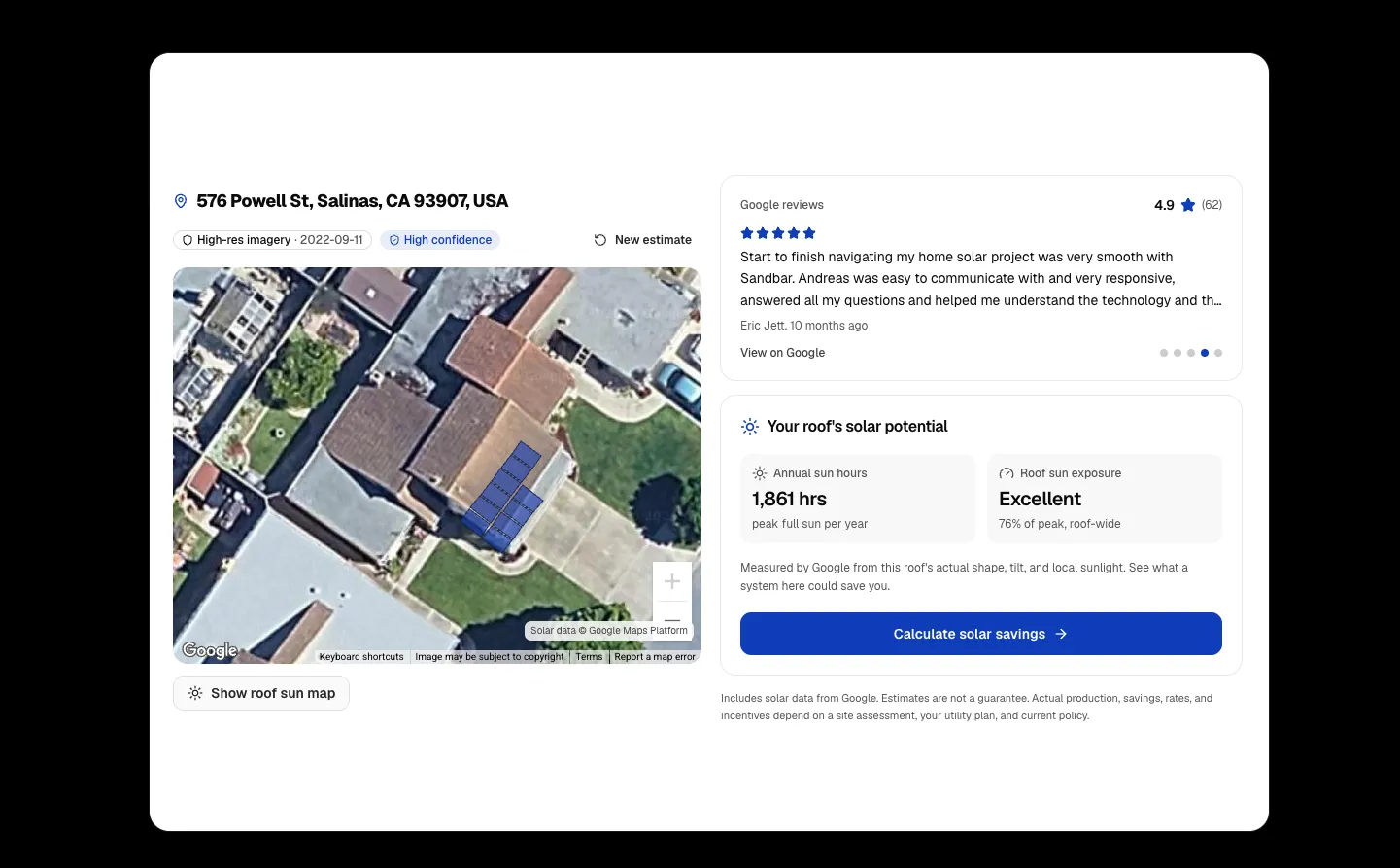
- One field to start: a home address, no name, no email, no phone
- The roof mapped from Google’s own solar data, using the actual shape, tilt and local sunlight rather than a square-footage guess
- Panels laid onto the real roof in the aerial view, so the homeowner sees a system on their house and not a stock illustration
- The confidence of the underlying data shown on its face: the imagery date and a high-confidence badge, so a stale or uncertain scan is not passed off as a fresh one
- The measurements that decide viability: annual peak sun hours and roof sun exposure as a share of peak, roof-wide
- A sun map view of the roof for anyone who wants to see where the good exposure actually is
- Savings modeled against California NEM 3.0, which is the whole point
- Google reviews pulled in beside the estimate, so the proof sits next to the number
- The limits stated plainly under the result: estimates are not a guarantee, and production, savings, rates and incentives depend on a site assessment, the utility plan and current policy
What it does now
A homeowner sees their own roof, their own sun numbers and a savings model built on the rules that actually apply, then decides whether to book. The conversation starts after the math instead of before it.